


Why the Same Cancer Diagnosis Can Lead to Different Treatment Decisions
A cancer diagnosis can lead to several possible treatment paths, but having more options does not always make the next decision clearer.
Personalized cancer treatment asks a more useful question: which approach fits the patient’s cancer, previous treatments, current medical condition, immune context, and goals?
Two people with the same diagnosis may receive different recommendations because their tumor biology, treatment history, physical condition, and priorities are not identical.
These differences matter because treatment decisions happen in sequence. What is chosen today may influence what remains possible later.
Understanding six key factors can help patients and families ask better questions and participate more meaningfully in treatment decisions.
Personalized Treatment Requires More Than Finding a New Therapy
Personalization is sometimes reduced to genetic testing or matching a tumor mutation with a drug.
That is only part of the picture.
Precision cancer treatment may use biomarkers and molecular findings to identify biological characteristics that could influence treatment selection. Personalized treatment planning is broader. It also considers disease extent, previous treatment response, medical readiness, immune activity, treatment timing, and patient goals.
This creates an important distinction:
An available treatment is not automatically an appropriate treatment.
Cancer can change during care. Resistance can develop. Blood counts, infections, organ function, nutritional status, and physical ability may also change.
For this reason, treatment plans may need repeated reassessment rather than one decision made at diagnosis.
In our ebook, NATURAL KILLER CELLS – A GUIDE FOR FAMILIES AND LOVED ONES OF STAGE 4 CANCER PATIENTS, we explain how immune coordination, treatment history, medical stability, and timing can shape the questions families ask when considering additional treatment options.
Why Immune Patterns Can Differ Between Patients
The relationship between the immune system and cancer is complex.
Tumors may interfere with immune recognition, suppress nearby immune activity, or develop mechanisms that help them resist immune attack. Previous treatments, infections, inflammation, nutritional decline, and advanced disease may also affect immune function.
These differences cannot be understood through one universal immune test.
Medical teams may consider pathology findings, biomarkers, blood counts, imaging, treatment response, and the patient’s overall condition.
Among the immune cells involved in cancer research are natural killer cells.
NK cells are part of innate immunity and participate in immune surveillance. Researchers continue studying how tumors interfere with NK-cell activity and how different cellular treatment approaches may use donor-derived, patient-derived, expanded, activated, or engineered NK cells.
These biological differences are one reason treatment decisions require individual evaluation.
The Goal Is to Identify Which Treatment Fits the Patient Now
Modern cancer treatment options may include surgery, radiation therapy, chemotherapy, hormone therapy, targeted cancer therapy, immunotherapy, cellular therapies, clinical trials, supportive care, or combinations of several approaches.
The goal of personalized cancer treatment is not to accumulate therapies.
It is to identify a medically reasonable strategy based on the patient’s disease, treatment history, current condition, and goals.
This becomes especially important when families research how immunotherapy works.
When patients ask how does immunotherapy work, the answer depends on the specific therapy.
Immunotherapy is a broad category of treatments that influence different parts of the immune response. Checkpoint inhibitors, monoclonal antibodies, cancer vaccines, CAR T-cell therapies, and NK-cell approaches work through different mechanisms.
Understanding the types of immunotherapy matters because these treatments are not interchangeable.
A useful approach to cancer immunotherapy explained is to ask what mechanism the treatment affects, what evidence supports its use, which patients may be considered, and how response will be monitored.
The immunotherapy treatment process can also vary according to the therapy, diagnosis, treatment protocol, and patient’s medical condition.
6 Proven Factors That Help Guide Personalized Cancer Treatment
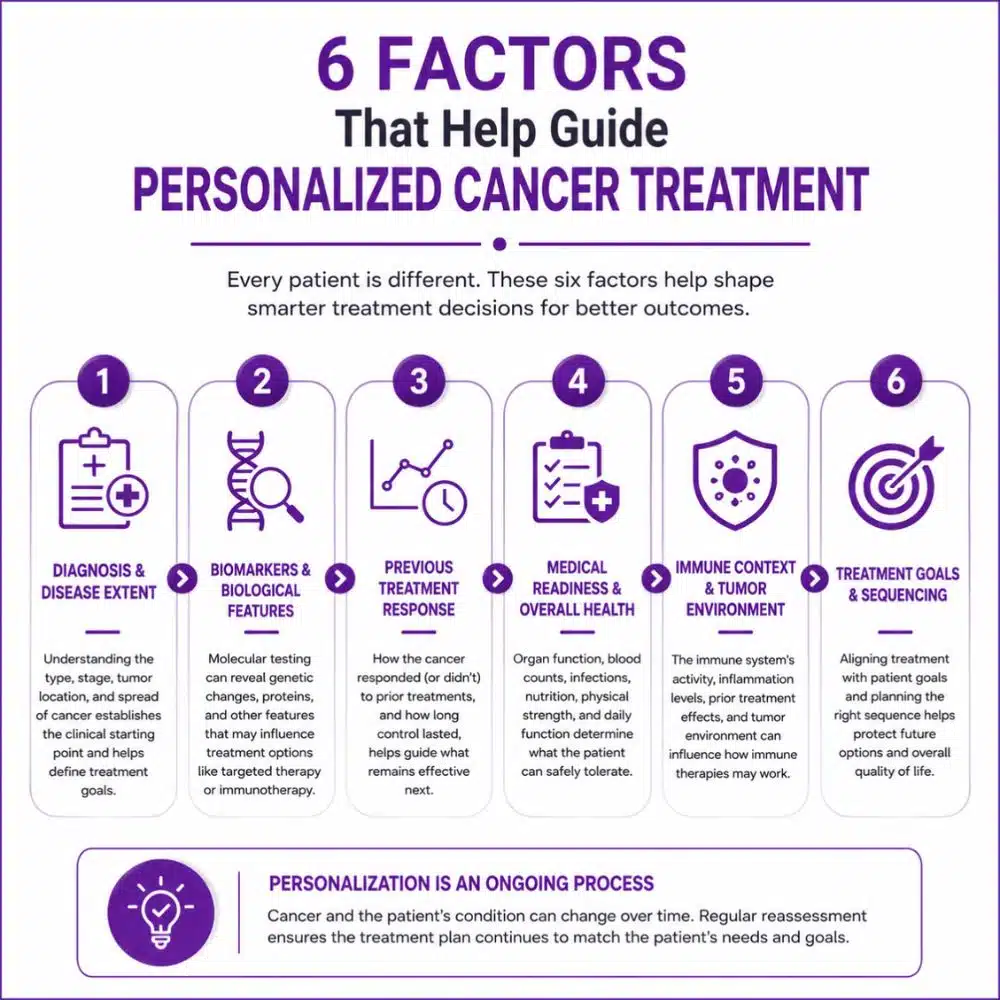
1. Diagnosis and Disease Extent Establish the Starting Point
Every treatment decision begins with understanding the cancer as accurately as possible.
Medical teams may evaluate the cancer type, pathology, stage, tumor location, metastatic sites, symptoms, complications, and rate of progression.
These findings help determine treatment goals and which approaches may deserve consideration.
However, stage alone does not explain every difference between patients.
Two people with advanced cancer may have different disease burdens, biomarkers, treatment histories, and physical conditions.
This is why personalized cancer treatment begins with the diagnosis but cannot end there.
Families can learn more about established treatment categories through the National Cancer Institute’s cancer treatment overview.
2. Biomarkers Can Reveal Differences That Influence Treatment Selection
Cancer cells may contain genetic alterations, proteins, receptors, or other biological characteristics that influence treatment decisions.
Biomarker testing can sometimes identify opportunities for precision cancer treatment, targeted therapies, certain immunotherapies, or clinical trials.
However, finding a biomarker does not guarantee that a treatment will work.
Cancer can evolve, different tumor cells may respond differently, and treatment resistance can develop.
Biomarker findings therefore need to be considered alongside diagnosis, treatment history, medical condition, and available evidence.
The U.S. Food and Drug Administration’s precision medicine resource provides additional information about molecular testing and treatment selection.
3. Previous Treatment Response Can Change Future Options
Treatment history provides more information than a list of therapies received.
Medical teams may consider whether the cancer responded, how long disease control lasted, whether progression occurred, whether resistance developed, and how previous treatments affected the patient.
Treatment sequencing matters as well.
A treatment selected now may influence whether another therapy, procedure, or clinical trial remains available later.
Good personalized treatment planning considers both the immediate decision and the broader direction of care.
4. Medical Readiness Helps Determine What the Patient May Tolerate
A treatment may have a reasonable scientific basis and still be unsuitable for a patient whose current condition creates significant concerns.
Medical teams may evaluate blood counts, organ function, infections, nutritional status, unintended weight loss, physical strength, daily function, other medical conditions, and recent treatments.
Sometimes the next appropriate step is not another cancer-directed therapy.
Addressing infection, dehydration, nutritional decline, uncontrolled symptoms, or physical weakness may need attention before additional treatment is evaluated.
Treatment availability and treatment readiness are not the same thing.
5. Immune Context Can Influence Treatment Evaluation
Cancer can interact with the immune system in several ways.
Tumors may reduce immune recognition, suppress nearby immune cells, or create conditions that interfere with antitumor activity.
This is why explaining how immunotherapy works requires more than saying that treatment “boosts the immune system.”
Different immunotherapies target different mechanisms.
NK-cell approaches involve natural killer cells, which participate in innate immune surveillance.
Whether an immune-based treatment deserves consideration depends on the cancer, previous therapies, medical stability, available evidence, treatment protocol, and individual patient circumstances.
6. Treatment Goals and Sequencing Help Protect Future Options
Before beginning another treatment, patients should understand its purpose.
Is the goal to eliminate localized disease, reduce tumor burden, slow progression, control symptoms, or preserve physical function?
Patient priorities also matter.
Some patients may want to pursue every medically reasonable opportunity. Others may prioritize independence, time with family, reduced treatment burden, or maintaining daily function.
Personalization brings medical evidence, clinical judgment, individual circumstances, and informed patient priorities together.
Patients may benefit from asking:
What evidence supports this treatment for my situation?
How will response be monitored?
What happens if the disease progresses?
Could this decision affect future treatment options?
The strongest strategy should explain both why a treatment is being considered and how it fits into what may come next.
How Our Treatment Environment Supports Individual Evaluation
At the US Mexico Cancer Institute, we believe treatment evaluation should help patients understand why an approach is being considered, what limitations remain, and how it fits into the broader care strategy.
Our process considers available medical records, diagnosis, previous treatments, current condition, treatment goals, medical stability, and factors that may influence candidacy or timing.
Why Patients Choose Our Approach
We differentiate ourselves in ways most providers cannot replicate:
- NK cells are always delivered fresh with zero cryopreservatives for functional potency
- Molecular hydrogen support to reduce immune interference
- National-level medical leadership guiding decisions
- COFEPRIS-aligned safety oversight
- White-glove care that protects timing and reduces stress
When patients compare options, one truth becomes clear:
Precision and timing shape what remains possible.
Patients can learn more about Mexico’s federal health regulatory authority through the official COFEPRIS website.
The Next Treatment Decision Should Clarify What Remains Reasonable
Personalized cancer treatment is an ongoing process.
Cancer can change. Resistance can develop. New biomarkers may be identified. A patient’s medical condition, organ function, nutritional status, and physical strength may also improve or decline.
The six factors in this article provide a practical framework for understanding those changes.
The goal is not to pursue every available treatment.
It is to identify which options remain medically reasonable, why they are being considered, and how the next decision fits into the larger care strategy.
At the US Mexico Cancer Institute, a conversation with a Patient Care Consultant can help families organize the medical information needed for further evaluation and understand whether an NK-cell treatment assessment may be appropriate.
Speak with a Patient Care Consultant to discuss your current medical circumstances and possible next steps.
This article is intended for educational and informational purposes only. It does not provide medical advice, diagnosis, or individualized treatment recommendations. Treatment eligibility and outcomes vary. Cancer treatment decisions should be made with qualified healthcare professionals who understand the patient’s complete medical circumstances.
Frequently Asked Questions
1. What is personalized cancer treatment?
Personalized cancer treatment uses information about the patient and the cancer to help guide care decisions, including diagnosis, biomarkers, treatment history, medical condition, immune context, treatment goals, and patient priorities.
2. Is precision cancer treatment the same as personalized treatment planning?
No. Precision cancer treatment generally emphasizes biomarkers and molecular characteristics. Personalized treatment planning is broader and may also consider previous treatments, medical readiness, treatment timing, future options, and patient goals.
3. Can biomarkers determine which cancer treatment will work?
No. Biomarkers may identify treatment opportunities, but they cannot guarantee a response. Cancer biology, resistance, previous treatments, and the patient’s medical condition can also influence outcomes.
4. How does immunotherapy fit into personalized cancer treatment?
Immunotherapy may be evaluated when the cancer diagnosis, biological characteristics, previous treatments, medical condition, and available evidence support an immune-based approach. Different types of immunotherapy have different mechanisms and patient-selection considerations.
5. Are natural killer cells appropriate for every cancer patient?
No. Treatment approaches involving natural killer cells require individual medical evaluation. Diagnosis, previous treatment history, organ function, active infections, physical condition, medical stability, available evidence, and the treatment protocol may influence candidacy.

- NK Cell Therapy in Mexico: Patient Guide for Cancer Treatment in Tijuana - August 25, 2026
- NK Cell Therapy Mexico 6 Essential Standards Patients Should Evaluate Before Treatment - August 18, 2026
- Alternative Cancer Treatments Mexico 6 Essential Questions Patients Should Ask About Evidence and Safety - August 11, 2026