
Choosing cancer care is a major decision. It can feel even harder when you are looking at treatment options in another country.
Searches for alternative cancer treatments Mexico may bring up many different therapies. Some may be used to support standard cancer care. Others may still be under study. Some may have very little research behind them.
That is why patients should not choose a treatment based on a strong claim, a testimonial, or a treatment name alone.
Instead, ask simple questions about the evidence, how the treatment fits into your care, who can receive it, and how the clinic monitors patients.
This guide covers six questions that can help patients and families make more informed choices when considering cancer treatment abroad.
What Do Alternative, Complementary, and Integrative Cancer Care Mean?
These terms are often used together, but they have different meanings.
Complementary care is used along with standard cancer treatment. Alternative care is used instead of standard treatment. Integrative care brings standard treatment together with selected complementary approaches. The National Cancer Institute explains these differences.
For example, a patient may use acupuncture to help manage certain symptoms while continuing their cancer treatment. That is different from replacing cancer treatment with an unproven therapy.
The National Center for Complementary and Integrative Health states that no complementary approach has been shown to cure cancer. It also advises patients to talk with their healthcare provider before adding a complementary approach to their care.
This difference is important when looking at alternative cancer treatment Mexico programs. Patients should know exactly how a proposed therapy is meant to fit into their care.
What Families Learn About Immune-Based Care
In our ebook, “Natural Killer Cells – A Guide for Families and Loved Ones of Stage 4 Cancer Patients,” families can learn why treatment decisions should start with the patient’s medical condition, not simply the name of a therapy.
The guide discusses the role of natural killer cells, immune response, treatment planning, and the questions families may have when considering immune-based care.
For families looking at integrative cancer treatment Mexico, this background can help them have clearer conversations with their medical team and better understand what a proposed treatment is designed to do.
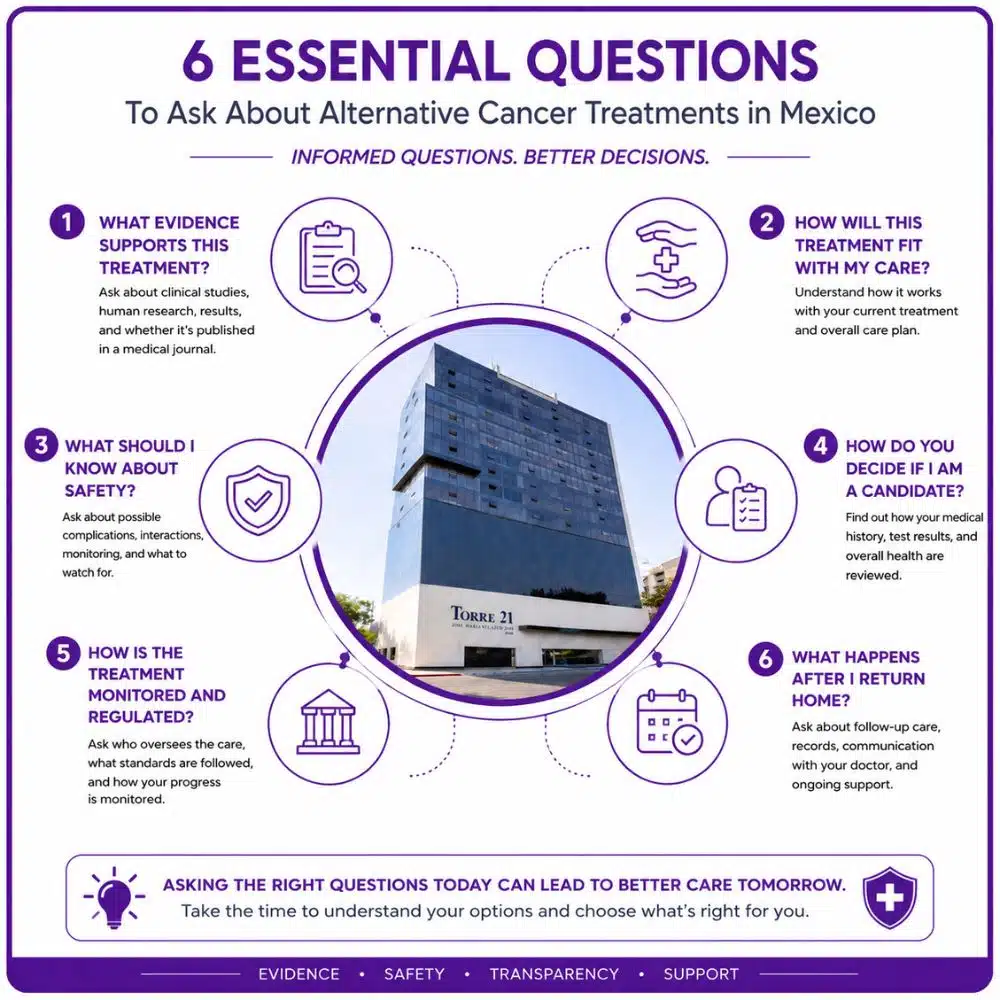
6 Essential Questions to Ask Before Choosing Alternative Cancer Treatment
1. What Research Supports This Treatment?
Start with the evidence.
A treatment may be supported by laboratory research, early human studies, larger clinical trials, or years of clinical use. These forms of evidence do not all carry the same weight.
If you are comparing alternative cancer treatment Mexico options, ask the clinic:
- Has this treatment been studied in people?
- Has it been studied for my type of cancer?
- How many patients were included?
- What did the study measure?
- Was the research published in a medical journal?
- Is the treatment well established or still being studied?
A result seen in a laboratory does not always produce the same result in people.
The NCCIH notes that some complementary approaches have useful evidence for certain cancer symptoms, while many other approaches still need more research.
When comparing treatment options, ask the medical team to explain what is known, what is still being studied, and how the research applies to your situation.
You should not need to understand complex medical terms to get a clear answer.
2. How Will This Treatment Fit With My Current Care?
This is one of the most important questions to ask.
If a clinic calls a treatment complementary or integrative, ask what that means for your current cancer care.
Will the treatment be used:
- along with your current treatment?
- after another treatment?
- to help manage certain symptoms?
- as part of a larger care plan?
- instead of another treatment?
The answer should be clear.
NCCIH advises patients not to use unproven products or practices to replace or delay cancer treatment. It also notes that some complementary approaches may interfere with medical treatment.
This is especially important when considering integrative cancer treatment Mexico or complementary cancer treatment Mexico. Ask the medical team to explain exactly how the proposed approach fits into your full care plan.
You should also be able to discuss the plan with your current healthcare providers.
3. What Should I Know About Treatment Safety?
Every medical treatment deserves a clear safety discussion.
If you are considering alternative cancer treatments Mexico, ask what you should know before treatment begins. This may include possible complications, medicine interactions, treatment monitoring, and situations that may require a change in the treatment plan.
This is especially important with supplements and products described as natural.
The NCCIH explains that natural does not always mean safe. Some supplements can interact with medicines, and the safety of some products is not well understood.
Make sure your medical team knows about every medicine, vitamin, supplement, and other treatment you use.
You can also ask:
“What should my doctor at home know about this treatment?”
That question can help improve communication between healthcare providers.
4. How Do You Decide if I Am a Good Candidate?
Not every treatment is right for every patient.
Before traveling for cancer care in Mexico, ask how the clinic reviews your medical history and decides whether you are a candidate.
A medical review may include:
- pathology reports
- imaging scans
- laboratory results
- previous cancer treatments
- current medicines
- medical history
- overall health
Ask who reviews your records and whether more information is needed before treatment is recommended.
This is an important difference when comparing cancer clinics in Mexico. A clinic that first studies your medical history is taking a different approach from one that simply offers the same treatment to every patient.
A personalized review can also help explain why a treatment may be considered for one patient but not another.
5. How Is the Treatment Monitored and Regulated?
Patients considering alternative cancer treatments Mexico should ask how the medical service and treatment process are monitored.
COFEPRIS is Mexico’s federal health authority responsible for areas that include regulation, control, and health surveillance. Patients can review the official COFEPRIS website to understand its role.
If you are comparing alternative cancer treatment Mexico options, ask the clinic how the treatment is provided, who oversees it, and what medical standards guide patient care.
Ask the clinic:
- Who oversees my treatment?
- What medical standards apply?
- How will my progress be monitored?
- How are my medical records kept?
- What happens if my treatment plan needs to change?
Patients exploring integrative cancer treatment Mexico should also ask how the proposed approach fits into their overall care plan and how communication is handled between the medical team and other healthcare providers.
At the US Mexico Cancer Institute, patients can ask these questions before making treatment decisions and discuss how a proposed approach may fit their individual medical situation.
There is also an important difference between regulation and medical evidence.
A treatment being offered within a regulated healthcare setting does not automatically prove that the treatment works for every type of cancer.
Patients should look at both the medical evidence and the way the treatment is provided.
6. What Happens After I Return Home?
This question is easy to forget when planning cancer treatment abroad.
Patients often focus on travel dates, appointments, and treatment costs. But follow-up care deserves the same attention.
Before traveling, ask:
- Who will review my follow-up results?
- Will I receive a copy of my treatment records?
- Can my doctor at home communicate with your team?
- How will follow-up appointments be handled?
- Who should I contact if I have questions after returning home?
- When should I have my next medical review?
A clear follow-up plan can make care easier to manage after you leave Mexico.
This is also an important point when comparing cancer clinics in Mexico. Look at what happens after treatment, not only what happens during your visit.
How to Compare Alternative Cancer Treatments in Mexico
Once you have answers to these questions, compare the information you receive.
Do not compare clinics only by the number of treatments they offer.
Instead, compare:
| What to Compare | Question to Ask |
|---|---|
| Evidence | What research supports the treatment? |
| Treatment role | How does it fit with my current care? |
| Safety | What should I know before treatment? |
| Patient selection | How do you decide who is a candidate? |
| Medical oversight | Who monitors the treatment? |
| Follow-up | What happens after I return home? |
This approach can help patients compare integrative cancer treatment Mexico programs in a more useful way.
It also helps separate medical information from marketing language.
Watch for Claims That Sound Too Good to Be True
Patients should be careful with claims such as:
- “works for every cancer”
- “guaranteed results”
- “miracle cure”
- “better than all standard treatments”
- “no need for conventional care”
The U.S. Food and Drug Administration warns consumers about cancer products promoted with unproven cure claims. The FDA also notes that testimonials are not a substitute for scientific evidence.
This does not mean patients should reject every newer or complementary approach.
It means claims should be checked.
Ask what research supports the claim, who conducted the research, and whether the findings apply to your type of cancer.
Why the Treatment Name Is Only One Part of the Decision
Patients searching for the best cancer treatment in Mexico may begin by comparing therapies.
But the treatment itself is only one part of the decision.
The medical team matters. The patient evaluation matters. Communication matters. Follow-up matters.
At the US Mexico Cancer Institute, our approach begins with understanding each patient’s medical history and current condition before discussing possible treatment options.
For patients considering alternative cancer treatment Mexico, this process helps place the treatment within a broader medical plan rather than treating it as a stand-alone answer.
Why Patients Choose the US Mexico Cancer Institute
At the US Mexico Cancer Institute, our approach focuses on personalized treatment planning, careful medical evaluation, and patient support throughout the care journey.
Our approach includes:
- Comprehensive medical review before treatment recommendations
- Fresh Natural Killer (NK) cells delivered without cryopreservatives
- Molecular hydrogen support as part of our treatment approach
- National-level medical leadership for clinical decision-making
- COFEPRIS-aligned medical oversight
- White-glove support for patients traveling for care
These standards give patients a clear starting point for asking questions and understanding how a proposed treatment may fit their individual needs.
Making an Informed Choice About Cancer Care in Mexico
Choosing among alternative cancer treatments Mexico can be difficult. A treatment may sound promising, but patients need more than a strong claim before making a medical decision.
Ask what research supports the treatment. Ask how it fits into your current care. Ask how the clinic decides who is a candidate. Ask how treatment is monitored and what happens after you return home.
These questions can help families compare cancer care in Mexico with greater clarity.
If you are considering cancer treatment abroad, take time to review your options with qualified healthcare professionals who understand your medical history.
The goal is not simply to find a treatment. It is to understand the treatment well enough to make an informed decision.
Frequently Asked Questions
1. Are alternative cancer treatments proven to cure cancer?
No. No complementary approach has been shown to cure cancer. Some complementary approaches may help with certain symptoms or support quality of life, but they should be discussed with your healthcare team. Patients considering alternative cancer treatments Mexico should also ask what evidence supports the specific treatment being offered.
2. What is the difference between alternative and complementary cancer treatment?
Alternative treatment is used instead of standard cancer care. Complementary treatment is used along with standard care. Integrative care combines standard treatment with selected complementary approaches. Patients researching alternative cancer treatment Mexico should ask whether a therapy is intended to replace standard care or work alongside it.
3. How can I evaluate an alternative cancer treatment in Mexico?
Ask about the research, how the treatment fits your care plan, how the clinic selects patients, how treatment is monitored, and what follow-up care is provided. If you are comparing integrative cancer treatment Mexico programs, ask the medical team to explain the treatment’s purpose, supporting evidence, and place within your overall care plan.
4. Does natural cancer treatment always mean safer care?
No. Natural products can still affect the body or interact with medicines. Safety depends on the specific product, how it is used, and the patient’s health. When considering complementary cancer treatment Mexico, tell your healthcare team about all medicines, supplements, and other therapies you currently use.
5. Should I change my current cancer treatment before trying an alternative approach?
Do not stop or change prescribed cancer treatment without first speaking with your healthcare team. A qualified medical professional can help you understand how a new approach may fit with your current care. This is especially important when considering alternative cancer treatments Mexico, because the proposed therapy should be reviewed in the context of your complete medical history.

- NK Cell Therapy in Mexico: Patient Guide for Cancer Treatment in Tijuana - August 25, 2026
- NK Cell Therapy Mexico 6 Essential Standards Patients Should Evaluate Before Treatment - August 18, 2026
- Alternative Cancer Treatments Mexico 6 Essential Questions Patients Should Ask About Evidence and Safety - August 11, 2026