
Choosing the best cancer treatment in Mexico requires more than finding advanced therapies. Patients and families need to understand how treatment decisions are made, how safety is evaluated, and whether care is appropriate for the patient’s current medical condition.
This matters for people considering cancer care in Mexico after previous treatments or changes in health. For families exploring cancer treatment abroad, informed decisions should begin with medical leadership, patient screening, treatment preparation, safety oversight, and clear communication.
At the US Mexico Cancer Institute, we believe patients should compare the standards behind care rather than choosing a provider based only on treatments, price, or location.
The Best Cancer Treatment in Mexico Depends on the Process Behind Care
Treatment names can attract attention. Immunotherapy, integrative care, and cellular therapies may all sound promising.
But the availability of a therapy does not mean it is appropriate for every patient.
Cancer develops within a complex biological environment. Previous treatments, infections, inflammation, medications, organ function, immune status, and disease progression may influence treatment readiness.
Patients comparing cancer clinics in Mexico should ask how candidacy is determined, what screening occurs before treatment, who reviews medical records, and how the team responds when a patient’s condition changes.
A responsible program should answer these questions clearly.
Better Treatment Decisions Begin With Understanding the Body
The immune system is a coordinated network that recognizes infection, responds to cellular stress, and helps identify certain abnormal cells.
Natural Killer cells are part of the innate immune system. NK cells respond to biological signals that influence whether they remain inactive or act against certain target cells.
The National Cancer Institute explains that immunotherapy includes treatments that help the immune system act against cancer, while different approaches influence immune activity in different ways.
Understanding immune function helps explain why evaluating cancer treatment options requires more than selecting a therapy. Previous treatments and changes in the patient’s health may influence what remains appropriate.
At the US Mexico Cancer Institute, timing-focused evaluation and precision immune coordination assessment help us examine factors that may influence treatment readiness.
A Guide for Families Facing Stage 4 Cancer Decisions
Families facing Stage 4 cancer often need to understand complex medical information while the patient’s condition and available options continue to change.
In our ebook, Natural Killer Cells: A Guide for Families and Loved Ones of Stage 4 Cancer Patients, we explain immune surveillance, the role of NK cells, what NK cell therapy is designed to do, and why candidacy, preparation, and treatment timing deserve careful evaluation.
Learning that a therapy exists is only the beginning. Families also need to understand whether the patient’s medical condition, treatment history, organ function, and overall stability support further evaluation.
Better information helps families ask better questions and compare the medical standards behind care.
What Families Learn From Real Immune Patterns
The immune system is not a switch that can simply be turned on.
NK cells respond to activating and inhibitory signals from cells and their surrounding environment. Researchers continue studying how these mechanisms may be used in cancer immunotherapy.
A peer-reviewed review indexed by PubMed discusses NK-cell biology and the continued development of NK-cell-based approaches for cancer treatment.
This matters because natural killer cell therapy should never be presented as an isolated product.
Patients considering NK cell cancer treatment should understand how treatment history, current health, immune function, stability, and timing influence medical planning.
The same principle applies to advanced cancer treatment options. More therapies do not automatically create better care. The quality of a strategy depends on why a treatment is selected and how it fits the patient’s condition.
Compare the Standards Behind Cancer Care
When evaluating a cancer center in Mexico, patients should look beyond treatment menus.
They should know who leads medical decisions, what information is reviewed before treatment, which screening standards are followed, and how care is adjusted when conditions change.
A responsible cancer care center should also explain eligibility requirements and medical records needed before international travel.
The goal is not to find the provider offering the most therapies.
The goal is to determine whether care is medically coordinated.
9 Trusted Standards Patients Should Compare Before Choosing Care
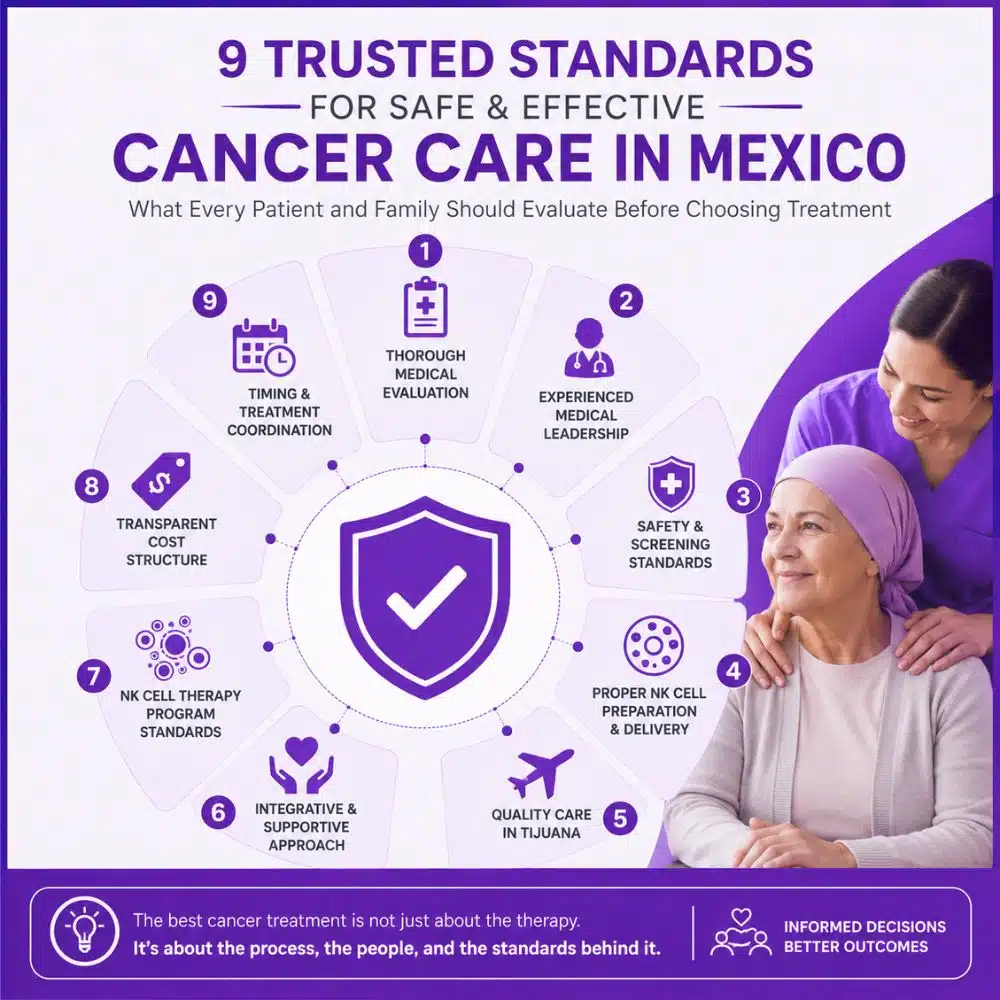
1. Require a Meaningful Medical Evaluation
Responsible planning begins with the patient.
The medical team should review diagnosis, pathology, imaging, previous treatments, medications, laboratory findings, symptoms, and organ function.
Patients exploring treatment options for cancer should understand what information is required and who reviews it before recommendations are made.
2. Identify Who Leads Medical Decisions
Patients should know who develops the treatment strategy, evaluates eligibility, and responds when medical conditions change.
This is especially important when several therapies are coordinated.
National-level medical leadership helps provide structured oversight and accountability. Patients deserve to know who is responsible for clinical decisions.
3. Examine Safety and Screening Standards
Safety begins before treatment.
Patients considering cellular therapy or other cancer therapy options should ask about infectious screening, genetic screening, laboratory procedures, patient eligibility, and clinical monitoring.
At the US Mexico Cancer Institute, our approach includes extensive infectious and genetic screening and COFEPRIS-aligned safety oversight.
Mexico’s Federal Commission for Protection against Health Risks (COFEPRIS) is responsible for health regulation, control, and surveillance within its jurisdiction.
Patients should understand the safety processes surrounding treatment before care begins.
4. Understand How Natural Killer Cell Therapy Is Prepared
Patients researching natural killer cell treatment or NK cell immunotherapy should ask how donors are screened, how cells are prepared and tested, whether cryopreservatives are used, and who determines candidacy.
At the US Mexico Cancer Institute, NK cells are always delivered fresh with zero cryopreservatives.
Treatment preparation matters, but it should remain connected to patient screening, medical oversight, and treatment timing.
5. Evaluate Cancer Treatment in Tijuana Beyond Location
Patients considering cancer treatment in Tijuana should evaluate the medical system behind the destination.
Families comparing Tijuana cancer treatment programs should understand what happens before travel, what records are reviewed, and how treatment readiness is determined.
A cancer clinic Tijuana patients consider should clearly explain communication, travel coordination, treatment schedules, and follow-up care.
Our white-glove patient experience is designed to reduce logistical uncertainty while protecting treatment timing.
6. Ask How Alternative and Integrative Treatments Fit the Strategy
Families exploring alternative cancer treatments Mexico often want options beyond a single approach.
Responsible integrative cancer treatment Mexico programs should explain why each intervention is considered, what purpose it serves, and how it is coordinated with other care.
The same principle applies to complementary cancer treatment programs.
At the US Mexico Cancer Institute, supportive strategies may include molecular hydrogen support to reduce immune interference when medically appropriate.
Each therapy should have a clear purpose within the treatment strategy.
7. Compare NK Cell Therapy in Mexico Through Process
Patients researching NK cell therapy Mexico should examine more than availability.
Families should ask how candidacy is evaluated, how donors are screened, how cells are prepared, whether cryopreservatives are used, who provides oversight, and how patients are monitored.
People considering natural killer cell therapy Mexico programs should understand that NK-cell-based treatments continue being researched across different cancer settings.
The same careful evaluation should apply when considering immunotherapy treatment programs in Mexico.
8. Understand What Influences NK Cell Therapy Cost
Families comparing nk cell therapy cost should ask what the quoted price includes.
Medical evaluation, laboratory testing, cell preparation, clinical supervision, supportive therapies, monitoring, accommodations, transportation, and follow-up services may influence total cost.
When comparing NK cell therapy cost Mexico providers quote, price should be considered alongside medical oversight and safety standards.
The same principle applies to cancer treatment cost Mexico patients encounter.
Cost transparency helps families understand the complete medical and financial commitment.
9. Consider Timing When Reviewing Cancer Treatment Options
A patient’s condition can change while treatment decisions are being considered.
Disease progression, infections, medications, previous therapies, immune changes, and organ function may influence what remains appropriate.
This is why timing matters when evaluating cancer treatment options.
At the US Mexico Cancer Institute, precision immune coordination assessment helps us examine factors that may influence treatment readiness.
The strongest strategy is not the one with the most therapies. It is the one built around the patient’s current condition, medical history, safety needs, and timing.
Why Patients Choose Our Approach
We differentiate ourselves in ways most providers cannot replicate:
• NK cells are always delivered fresh with zero cryopreservatives for functional potency
• Molecular hydrogen support to reduce immune interference
• National-level medical leadership guiding decisions
• COFEPRIS-aligned safety oversight
• White-glove care that protects timing and reduces stress
When patients compare options, one truth becomes clear:
Precision and timing shape what remains possible.
Better Standards Create More Informed Treatment Decisions
Finding the best cancer treatment in Mexico requires more than comparing therapies.
Families should understand how patients are evaluated, who leads medical decisions, what safety standards guide care, how treatments are prepared, and how the medical team responds when conditions change.
These standards help patients compare cancer care in Mexico and evaluate cancer treatment abroad with greater confidence.
They also provide clear paths for learning more about natural killer cell therapy, cancer centers in Mexico, treatment in Tijuana, alternative and integrative care, NK cell therapy programs, treatment costs, and broader cancer treatment options.
At the US Mexico Cancer Institute, we help families understand the medical, biological, safety, and timing factors that may influence treatment planning.
The next step is not choosing the largest treatment package.
It is understanding the patient clearly enough to determine what options may still be appropriate.
FAQs
1. How should patients compare the best cancer treatment in Mexico?
Patients should examine medical leadership, pre-treatment evaluation, safety oversight, treatment preparation, monitoring, and the reasoning behind treatment recommendations.
2. What should families know before considering NK cell therapy?
Families should understand candidacy, donor screening, cell preparation, cryopreservation practices, medical oversight, and how treatment fits the broader strategy.
3. What should patients evaluate before traveling to Tijuana for cancer treatment?
Patients should review eligibility requirements, medical leadership, safety procedures, treatment preparation, travel coordination, communication, monitoring, and follow-up care.
4. What influences the cost of NK cell treatment?
Costs may vary based on evaluation, laboratory testing, cell preparation, medical supervision, supportive therapies, monitoring, accommodations, transportation, and follow-up services.
5. How should families evaluate alternative or integrative cancer treatment programs?
Families should ask why each therapy is recommended, what purpose it serves, how it is coordinated with other care, what safety standards apply, and how continued appropriateness is evaluated.

- NK Cell Therapy in Mexico: Patient Guide for Cancer Treatment in Tijuana - August 25, 2026
- NK Cell Therapy Mexico 6 Essential Standards Patients Should Evaluate Before Treatment - August 18, 2026
- Alternative Cancer Treatments Mexico 6 Essential Questions Patients Should Ask About Evidence and Safety - August 11, 2026