
Why Early Treatment Planning Matters More Than Many Families Realize
After a cancer diagnosis, patients are often presented with a large amount of information in a short period of time. Test results, physician consultations, treatment recommendations, and scheduling discussions can quickly become overwhelming.
Many families immediately focus on one question:
Which treatment should we choose?
While that question is important, experienced cancer teams often begin with a different consideration.
How treatment decisions are made early may influence future options later.
At the US Mexico Cancer Institute, we frequently see patients researching cancer treatment planning after realizing that treatment pathways are not always fixed. Decisions made during the first stages of care may affect future evaluations, recovery planning, treatment sequencing, and long-term care discussions.
Understanding these considerations may help families approach treatment planning with greater confidence and awareness.
Why Cancer Treatment Planning Is More Than Choosing a Therapy
Many people assume cancer treatment planning involves selecting a single treatment and following a predetermined path.
In reality, cancer care planning often evolves throughout treatment.
A patient’s condition may change because of:
- recovery patterns
- disease progression
- nutritional status
- inflammatory activity
- treatment response
This explains why cancer treatment decisions are rarely based on one factor alone.
The National Cancer Institute explains that cancer treatment plans are often individualized based on disease characteristics, patient health, and treatment goals.
Families researching treatment options for cancer may benefit from understanding that planning is not simply about selecting a therapy. It is also about creating a strategy that can adapt as circumstances change.
What Families Learn From Real Treatment Journeys
In our ebook, “NATURAL KILLER CELLS – A GUIDE FOR FAMILIES AND LOVED ONES OF STAGE 4 CANCER PATIENTS”, we discuss how patients often experience changing treatment needs over time.
Families are frequently surprised to learn that cancer care planning continues evolving throughout treatment rather than ending after the initial consultation.
New information may emerge through:
- diagnostic testing
- treatment monitoring
- recovery observations
- physician evaluations
This is one reason many treatment plans require ongoing review instead of remaining static from diagnosis through recovery.
Understanding this reality can help reduce uncertainty when treatment recommendations change during care.
Why Flexible Planning Often Supports Better Decision-Making
Patients sometimes view treatment planning as a one-time event.
However, effective cancer treatment planning often involves ongoing evaluation.
At the US Mexico Cancer Institute, we encourage families to think about planning as a process rather than a single decision.
This approach may help patients better understand:
- treatment timing
- future care options
- recovery priorities
- evolving treatment goals
- long-term care considerations
The goal is not simply to choose a treatment.
The goal is to create a framework that allows future decisions to be made with greater clarity as new information becomes available.
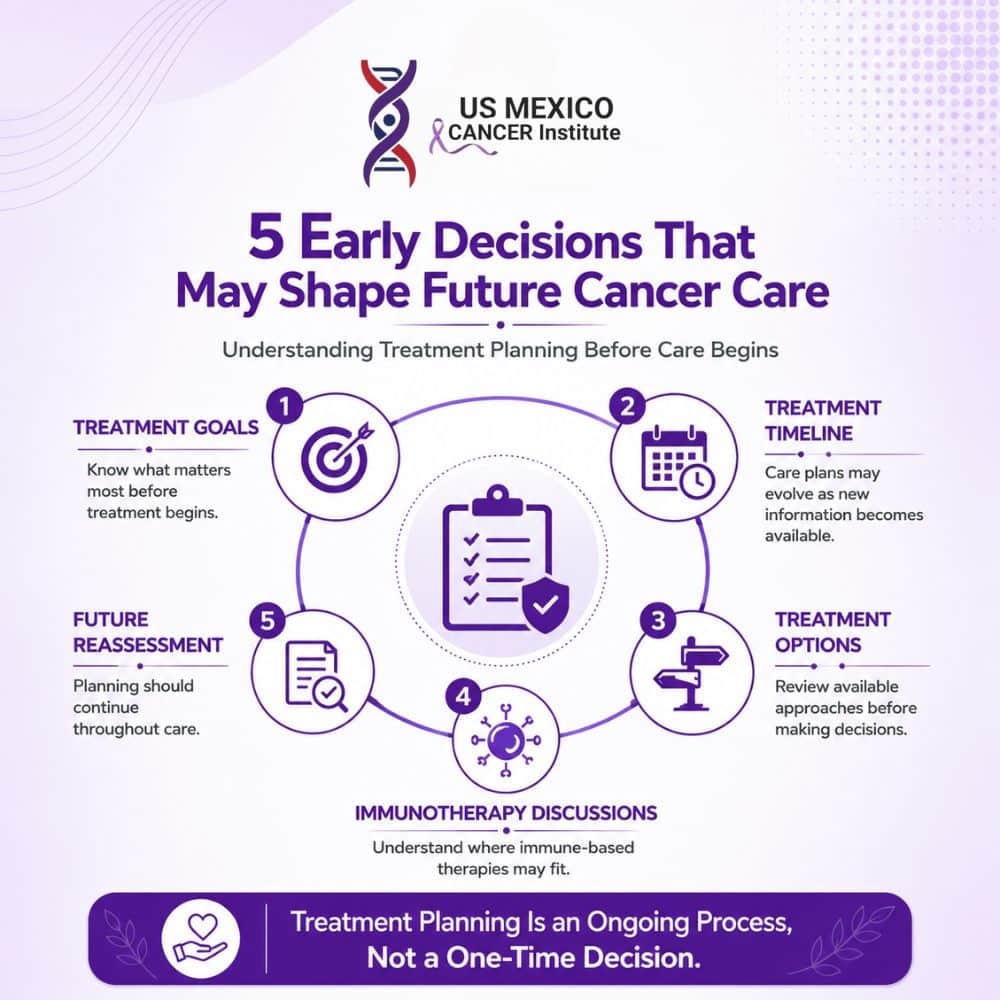
5 Early Decisions That May Change Future Care Options
1. Establishing Clear Treatment Goals
One of the earliest and most important discussions involves identifying treatment goals.
Patients may have different priorities regarding:
- quality of life
- symptom management
- treatment intensity
- recovery expectations
- long-term planning
These goals often influence future cancer treatment decisions.
When treatment goals are clearly defined, patients may find it easier to evaluate recommendations as care progresses.
2. Understanding the Cancer Treatment Timeline
Many families assume treatment follows a predictable schedule.
In reality, the cancer treatment timeline may change based on:
- physician evaluation
- recovery status
- treatment response
- new diagnostic findings
Understanding this possibility early can reduce frustration when schedules evolve during care.
Flexible expectations often help families navigate changing circumstances more effectively.
3. Reviewing All Available Treatment Options
Patients sometimes focus only on the first recommendation they receive.
However, reviewing broader treatment options for cancer may help families better understand the range of available approaches.
Different treatment discussions may involve:
- systemic therapies
- localized treatments
- supportive care strategies
- emerging treatment approaches
Evaluating multiple options can help patients make more informed decisions while maintaining perspective on future possibilities.
4. Understanding How Immunotherapy Fits Into Planning
Many patients researching how immunotherapy works are trying to understand where immune-based approaches fit within broader cancer care planning.
The answer depends on multiple factors.
The immune system and cancer continue interacting throughout treatment, which is why immunotherapy discussions often involve more than treatment selection alone.
Families researching how does immunotherapy work frequently discover that immune-based therapies may be discussed differently depending on diagnosis, treatment history, and individual patient considerations.
The American Cancer Society provides educational resources that explain how different types of immunotherapy may be used across cancer care discussions.
Understanding these factors may help patients better evaluate treatment recommendations when discussing cancer immunotherapy explained resources and broader cancer care planning.
5. Planning for Future Reassessment
Perhaps the most overlooked decision involves preparing for future reassessment.
Cancer treatment planning should not end after the first consultation.
Ongoing evaluation may include:
- imaging reviews
- recovery assessments
- treatment monitoring
- symptom evaluation
- physician follow-up
This process helps ensure that future decisions are based on current information rather than assumptions made earlier in care.
Patients who expect reassessment often feel more prepared when treatment plans evolve over time.
Why Treatment Plans Continue Changing During Care
One reason cancer care planning can feel confusing is that patients expect certainty.
Cancer care rarely follows a perfectly predictable path.
New information may emerge through:
- treatment response observations
- laboratory testing
- imaging results
- recovery monitoring
These changes do not necessarily indicate problems.
Instead, they often reflect the reality that cancer treatment planning is an ongoing process designed to adapt as circumstances change.
Understanding this concept may help families feel more comfortable when treatment discussions evolve.
Why Patients Evaluate More Than Treatment Categories
Families researching cancer care often compare therapies first.
However, many patients also begin evaluating:
- treatment coordination
- recovery support
- physician communication
- timing considerations
- overall treatment environment
At the US Mexico Cancer Institute, our approach includes:
• NK cells are always delivered fresh without cryopreservatives to preserve cellular viability
• Molecular hydrogen support designed to reduce immune interference
• Physician-guided treatment coordination
• Treatment protocols guided by COFEPRIS-aligned safety standards
• Personalized support focused on recovery, timing, and patient experience
These factors may help families approach treatment decisions with greater clarity before care begins.
Why Planning Early Can Support Future Decisions
Cancer treatment planning is not simply about choosing a therapy.
It involves understanding how decisions made today may influence future options, treatment discussions, and care priorities.
As treatment progresses, circumstances may change. Recovery patterns evolve. New information becomes available. Treatment recommendations may be adjusted.
Patients who understand this process often feel better prepared to navigate those changes.
At the US Mexico Cancer Institute, we believe informed planning helps families approach treatment discussions with greater confidence, clarity, and perspective throughout the cancer care journey.
FAQs
1. What is cancer treatment planning?
Cancer treatment planning is the process of evaluating treatment recommendations, goals, timelines, and future care considerations before and during treatment.
2. Why do cancer treatment plans change?
Treatment plans may change because of recovery patterns, physician evaluations, treatment response, or new clinical information.
3. What is a cancer treatment timeline?
A cancer treatment timeline outlines the expected sequence of evaluations, treatments, monitoring, and follow-up care.
4. How does immunotherapy fit into treatment planning?
Immunotherapy may be considered as part of broader cancer care planning depending on diagnosis, treatment history, and individual patient factors.
5. Why is future reassessment important?
Regular reassessment helps ensure treatment decisions are based on current information and evolving patient needs.

- NK Cell Therapy in Mexico: Patient Guide for Cancer Treatment in Tijuana - August 25, 2026
- NK Cell Therapy Mexico 6 Essential Standards Patients Should Evaluate Before Treatment - August 18, 2026
- Alternative Cancer Treatments Mexico 6 Essential Questions Patients Should Ask About Evidence and Safety - August 11, 2026