
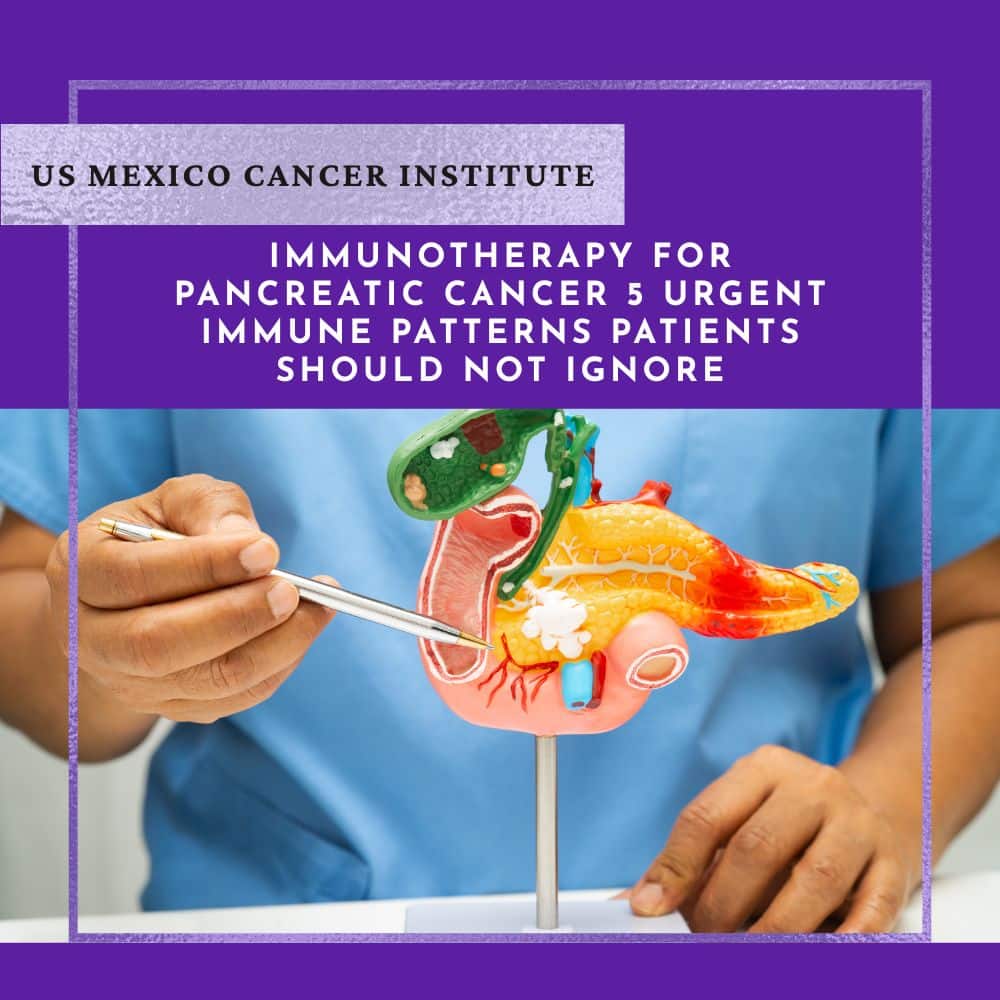
Immunotherapy for Pancreatic Cancer — Why Patients Reach This Stage
Immunotherapy for pancreatic cancer becomes part of the conversation when answers begin to feel incomplete.
Patients and families have already reviewed pancreatic cancer treatment options. They understand procedures, timelines, and possible outcomes. They may have been told what comes next.
Still, something feels unresolved.
The plan explains what will be done.
It does not fully explain what is still happening inside the body.
At US Mexico Cancer Institute, we meet patients at this exact moment every day.
Many arrive believing that once a diagnosis progresses, the immune system is no longer involved. What we explain instead is different.
The immune system often remains active longer than expected.
Natural killer cells are frequently still present, even when pancreatic cancer therapy has already begun.
The issue is not absence.
It is reduced clarity.
Understanding this distinction changes how decisions are made.
What Patients Are Told vs What We See
Patients exploring pancreatic cancer treatment are often guided through structured pathways.
This creates a belief:
- Treatment follows a fixed sequence
- Outcomes depend only on medical procedures
- The immune system has a limited role
What we observe is different.
The body is not static.
Immune coordination shifts.
Inflammation affects signaling.
Cell communication changes over time.
The National Cancer Institute explains that natural killer cells can identify abnormal cells without prior exposure.
This means immune activity continues to matter throughout pancreatic cancer therapy.
In our ebook “Natural Killer Cells – A Guide for Families and Loved Ones of Stage 4 Cancer Patients”, we explain that immune exhaustion is often misunderstood. The immune system often remains active but becomes less coordinated.
This reframes the situation.
The decision is no longer only about selecting treatment.
It becomes about evaluating whether the body is still able to respond.
5 Urgent Immune Patterns Patients Should Not Ignore
Why These Patterns Matter Before Treatment Decisions
At US Mexico Cancer Institute, we begin with evaluation.
These five immune patterns help patients understand how immunotherapy for pancreatic cancer aligns with the body and why timing shapes outcomes.
1. Natural Killer Cells Often Remain Active Even When Symptoms Progress
Many patients assume immune response disappears as the condition advances.
What we see is different.
Natural killer cells often remain measurable.
They continue monitoring abnormal cellular behavior in tissues and blood.
Their function does not depend on prior exposure.
They respond to changes in cell identity.
However:
- coordination may weaken
- signaling may become less precise
- response may become less structured
This is why nk cell treatment begins with evaluation.
It is based on function, not assumption.
In many cases, NK cells are still present but affected by signaling interference.
2. Inflammation Reduces Immune Signal Clarity
Inflammation plays a central role in pancreatic conditions.
When inflammation remains elevated:
- immune communication becomes less clear
- signaling pathways weaken
- coordination becomes less precise
This creates a state where the immune system is active but less organized.
Research supported by the National Institute of Allergy and Infectious Diseases shows that chronic inflammation disrupts immune signaling.
Reducing interference helps improve clarity.
This directly affects how immunotherapy for pancreatic cancer aligns with the body.
3. Timing Changes What Still Aligns With the Body
Timing is one of the most important factors in decision-making.
As immune coordination changes:
- some pancreatic cancer treatment options align better
- others become less effective
- response patterns shift
Patients often assume options remain stable.
In reality, alignment changes over time.
For patients exploring cancer treatment in mexico, this becomes a defining factor.
Early evaluation helps preserve alignment.
Waiting allows interference to increase and options to narrow.
4. Immune Coordination Fluctuates During Treatment
Immune activity is dynamic.
Patients may experience periods where:
- signaling becomes clearer
- coordination improves
- response becomes more structured
These shifts are influenced by:
- treatment cycles
- inflammation levels
- recovery patterns
At US Mexico Cancer Institute, we track these changes carefully.
We look for windows where immune coordination improves.
These windows often represent opportunities where nk cell treatment or other approaches may align more precisely.
Understanding these patterns helps patients move away from fixed assumptions and toward timing-based decisions.
5. Cost Does Not Reflect Biological Readiness
Patients often ask about nk cell therapy cost mexico when comparing options.
Cost matters.
It does not define alignment.
Two patients may receive similar therapies but experience very different outcomes.
The difference is not the therapy itself.
It is:
- immune coordination
- timing
- biological condition
This is why decisions should begin with evaluation.
Not comparison.
How These Patterns Shape Pancreatic Cancer Treatment Decisions
Patients often focus on procedures because they are clear and structured.
However, understanding immune patterns adds clarity.
For example:
- Pancreatic cancer treatment may include surgery, medication, or immune-based approaches
- Pancreatic cancer therapy depends on how the body responds
- Immunotherapy for pancreatic cancer depends on immune coordination
- NK cell treatment depends on how well immune systems are functioning together
When immune signals are clear, alignment improves.
When signals are disrupted, outcomes become less predictable.
This is why treatment decisions should reflect both medical planning and immune readiness.

How NK Cell Treatment Is Evaluated
At US Mexico Cancer Institute, immune therapy is never automatic.
Before recommending nk cell treatment, we evaluate how natural killer cells function within the current immune environment.
We assess:
• NK cell responsiveness
• Levels of inflammation affecting communication
• Immune signaling patterns
• Oxidative stress levels
• Effects of recent treatments
• Overall immune coordination
In many patients, NK cells remain measurable even when coordination weakens.
The issue is not disappearance.
It is signaling interference.
We also identify timing windows where coordination improves.
This ensures decisions reflect measurable biology.
Why Patients Choose Our Approach
We differentiate ourselves in ways most providers cannot replicate:
• NK cells prepared with zero cryopreservatives for functional potency
• Molecular hydrogen support to reduce immune interference
• National-level medical leadership guiding decisions
• COFEPRIS-aligned safety oversight
• White-glove care that protects timing and reduces stress
At US Mexico Cancer Institute, safety and precision guide every step.
Our processes align with standards established by COFEPRIS, Mexico’s Federal Commission for the Protection Against Sanitary Risk.
Patients searching for the best cancer clinic in tijuana mexico are often seeking clarity beyond simple availability.
When patients compare options, one truth becomes clear:
Precision and timing define what remains possible.
How This Changes the Decision
Understanding these immune patterns changes how patients evaluate pancreatic cancer therapy.
It shifts the focus from selecting treatments to understanding readiness.
At US Mexico Cancer Institute, we guide patients through structured evaluation so decisions reflect biology.
Timing Matters Now
Immune coordination changes over time.
What aligns today may not align in the same way later.
At US Mexico Cancer Institute, we see how early evaluation leads to more precise decisions while coordination still remains.
If you are exploring immunotherapy for pancreatic cancer, reviewing pancreatic cancer treatment options, or considering cancer treatment in mexico, this is the moment to act.
Evaluate immune readiness now.
Protect timing now.
Preserve options while alignment still exists.
FAQs
1. What is immunotherapy for pancreatic cancer?
It is an approach that supports the immune system’s ability to recognize abnormal cells.
2. Does pancreatic cancer therapy include immunotherapy?
In some cases, yes. It depends on immune readiness and alignment.
3. Do natural killer cells still function in pancreatic cancer?
Yes. They are often present but may have reduced coordination.
4. What is nk cell treatment?
It evaluates immune coordination before therapy decisions.
5. Does nk cell therapy cost mexico determine effectiveness?
No. Effectiveness depends on biological alignment and timing.

- NK Cell Therapy in Mexico: Patient Guide for Cancer Treatment in Tijuana - August 25, 2026
- NK Cell Therapy Mexico 6 Essential Standards Patients Should Evaluate Before Treatment - August 18, 2026
- Alternative Cancer Treatments Mexico 6 Essential Questions Patients Should Ask About Evidence and Safety - August 11, 2026