
Immunotherapy for Lung Cancer — Why Patients Start Looking Deeper
Immunotherapy for lung cancer often becomes part of the discussion when standard explanations stop feeling complete.
Patients and families may already understand the diagnosis. They have reviewed scans, pathology reports, and possible timelines. They may have discussed surgery, medications, and other lung cancer treatments with their medical team.
Still, one question remains:
Why do similar treatment plans create different outcomes?
At US Mexico Cancer Institute, we see this moment often.
Many patients arrive believing success depends only on the procedure itself. What we explain is different.
The body continues to change.
The immune system continues to respond.
Natural killer cells often remain active even when the condition feels advanced.
The issue is rarely that the immune system disappears.
The issue is that coordination becomes weaker.
Signals become harder to interpret.
Inflammation creates interference.
Timing changes what still aligns.
Understanding this changes how patients evaluate immunotherapy for lung cancer.
The decision becomes larger than selecting therapy.
It becomes about whether the body can still respond clearly.
What Patients Are Told vs What We See
Most patients exploring lung cancer therapy are guided toward a treatment sequence.
This creates a simple belief:
Treatment determines outcome.
What we observe is different.
The body is not static.
Immune coordination changes over time.
Inflammation affects recognition.
Cell communication influences response.
The National Cancer Institute explains that natural killer cells can identify abnormal cells without prior immune exposure.
This matters because lung cancer natural killer cells remain relevant even when other immune pathways become slower.
In our ebook, “Natural Killer Cells – A Guide for Families and Loved Ones of Stage 4 Cancer Patients”, we explain that immune exhaustion is often misunderstood.
Families often assume immune activity is gone.
What we see instead is immune confusion.
The immune system may still be active, but signaling becomes less precise.
This changes the question.
It is no longer only about choosing treatment.
It becomes about whether immune coordination is still clear enough for treatment to align.
What Families Learn From Real Immune Patterns
At US Mexico Cancer Institute, many of these patterns are explained in greater detail in our ebook, “Natural Killer Cells – A Guide for Families and Loved Ones of Stage 4 Cancer Patients”.
One of the most important insights families learn is this:
The immune system often remains active longer than expected.
In many cases, what appears to be immune decline is actually reduced coordination. Natural killer cells may still be present, but their signaling becomes less clear because of inflammation, treatment effects, or prolonged biological stress.
This distinction changes decision-making.
Instead of assuming the immune system is no longer responding, families begin asking a better question:
Is the immune system still able to coordinate effectively?
This helps patients understand why timing matters and why structured assessment is necessary before considering nk cell treatment or other immune-based strategies.
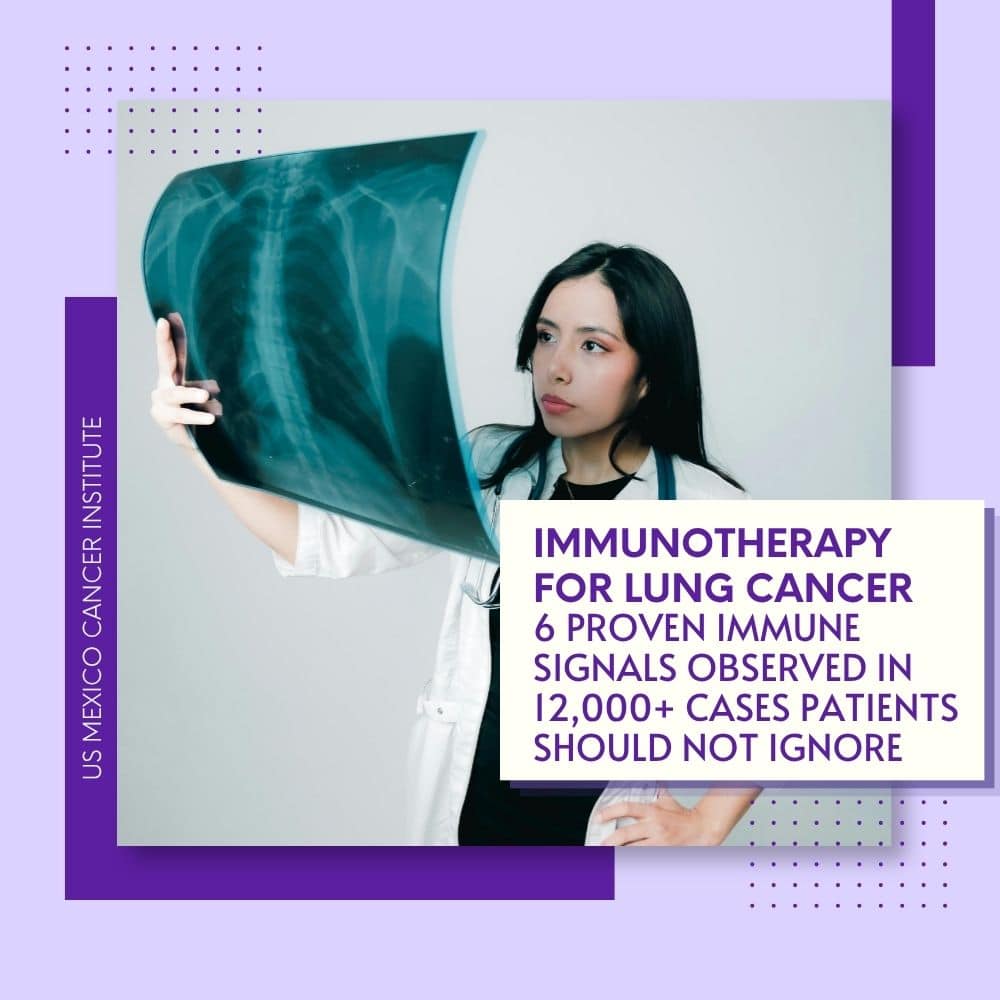
6 Proven Immune Signals Patients Should Not Ignore
Why These Signals Matter More Than Treatment Selection
At US Mexico Cancer Institute, we do not begin with treatment selection.
We begin with how the body is functioning.
Across thousands of patients, one pattern repeats:
The immune system often remains active.
What changes is how clearly it communicates.
These six immune signals explain why two patients with similar diagnoses may respond very differently to the same lung cancer therapy.
They also explain why timing matters more than most patients realize.
1. Natural Killer Cells Often Remain Active
Natural killer cells are part of the body’s early immune response.
They help identify abnormal cellular behavior before immune memory is required.
In many patients, lung cancer natural killer cells remain measurable even when disease has progressed.
However, presence does not always mean performance.
NK cells may still exist, but:
- signaling becomes weaker
- recognition becomes less precise
- coordination with other immune cells declines
This creates a gap between immune activity and immune effectiveness.
This is why nk cell treatment begins with evaluation.
We do not ask only whether NK cells are present.
We ask whether they are still responding clearly.
That difference shapes treatment decisions.
2. Inflammation Creates Immune Noise
Inflammation is one of the most overlooked parts of immunotherapy for lung cancer.
When inflammation remains elevated:
- immune signals become distorted
- cell communication becomes less accurate
- treatment alignment becomes harder to predict
The immune system remains active, but clarity is reduced.
Research supported by the National Institute of Allergy and Infectious Diseases shows that chronic inflammation interferes with immune signaling pathways.
Many patients focus on increasing immune activity when the real issue is often clarity.
Reducing immune interference often improves coordination more effectively than increasing intensity.
This is why inflammation management is part of how we evaluate top immunotherapy treatments for cancer.
3. Timing Changes Which Treatments Still Align
Patients often ask which therapy is best.
The answer depends on timing.
As immune coordination changes:
- some lung cancer treatments align better
- others become less effective
- response patterns shift
What works early may not work later in the same way.
This is one reason patients can receive similar treatment plans and experience very different outcomes.
At US Mexico Cancer Institute, we focus on identifying:
- when immune coordination is strongest
- when signaling is clearest
- when the body is most responsive
Timing is a measurable biological factor.
4. Immune Coordination Changes During Treatment Cycles
Immune response is never fixed.
Patients often experience periods where:
- signaling improves
- inflammation decreases
- immune communication becomes clearer
These periods matter.
They create windows where treatment alignment improves.
During these windows:
- response may become stronger
- decision-making becomes more precise
- nk cell treatment may align more effectively
Most treatment plans do not track these windows.
At US Mexico Cancer Institute, we do.
This allows therapy decisions to reflect timing instead of routine scheduling.
5. Cost Does Not Determine Biological Readiness
Patients often ask about access and affordability when comparing immunotherapy for cancer treatment.
Cost matters.
It does not determine whether the body is ready.
Two patients may receive similar therapies with very different outcomes.
The difference often reflects:
- immune coordination
- inflammation levels
- biological timing
This is why evaluation must come before comparison.
Biology decides alignment.
Not price.
6. Individual Evaluation Matters More Than General Statistics
Many patients search for averages.
They want survival rates, timelines, and percentages.
These numbers are useful.
They do not define individual biology.
No two immune systems respond the same way.
This is why immunotherapy for lung cancer cannot be evaluated through general statistics alone.
At US Mexico Cancer Institute, we guide patients through individualized immune evaluation.
This creates decisions based on measurable readiness instead of assumptions.
That clarity protects time.
How These Signals Change Lung Cancer Treatment Decisions
Understanding these signals changes how patients evaluate lung cancer therapy.
Instead of asking:
Which treatment is strongest?
The better question becomes:
Which treatment aligns with the body right now?
This applies to:
- surgery decisions
- medication timing
- immune-based approaches
- immunotherapy for lung cancer pathways
When immune signals are clear:
- alignment improves
- response becomes more structured
- decisions become more precise
When signals are disrupted:
- outcomes become less predictable
- timing becomes more urgent
This shift helps patients move from uncertainty toward clarity.
How NK Cell Treatment Is Evaluated
At US Mexico Cancer Institute, immune therapy is never automatic.
Before recommending nk cell treatment, we evaluate how natural killer cells function inside the current immune environment.
We assess:
• NK cell responsiveness
• Inflammatory burden
• Cytokine signaling patterns
• Oxidative stress levels
• Effects of recent treatments
• Overall immune coordination between cell systems
In many patients, NK cells remain measurable even when coordination weakens.
The issue is rarely disappearance.
It is signaling interference.
We also identify timing windows where immune clarity improves.
This helps ensure therapy decisions reflect biology rather than assumption.
Why Patients Choose Our Approach
We differentiate ourselves in ways most providers cannot replicate:
• NK cells prepared with Zero Cryopreservatives for functional potency
• Molecular hydrogen support to reduce immune interference
• National-level medical leadership guiding decisions
• COFEPRIS-aligned safety oversight
• White-glove care that protects timing and reduces stress
At US Mexico Cancer Institute, precision and safety guide every decision.
Our protocols align with standards established by COFEPRIS, Mexico’s Federal Commission for the Protection Against Sanitary Risk.
Patients searching for the best cancer clinic in tijuana mexico are often seeking clarity beyond simple availability.
When patients compare options, one truth becomes clear:
Precision and timing shape what remains possible.

Timing Matters Now
Immune coordination changes over time.
What aligns today may not align later.
At US Mexico Cancer Institute, we see how early evaluation creates better decisions while immune clarity still remains.
If you are exploring immunotherapy for lung cancer, reviewing lung cancer treatments, or considering broader immunotherapy for cancer treatment, this is the moment to act.
Evaluate immune readiness now.
Protect timing now.
Preserve options while alignment still exists.
FAQs
1. What is immunotherapy for lung cancer?
It is a treatment approach that helps the immune system recognize and respond to abnormal cells more effectively.
2. Do natural killer cells still function in lung cancer?
Yes. Natural killer cells are often still present, but their coordination may weaken depending on inflammation and immune signaling.
3. What is nk cell treatment?
It is an approach that evaluates how NK cells are functioning before deciding whether immune-based therapy is appropriate.
4. Are lung cancer treatments affected by timing?
Yes. Timing affects how well treatments align with immune coordination and overall biological readiness.
5. Why do patients search for the best cancer clinic in tijuana mexico?
Many patients are looking for precision, timing, and structured immune evaluation when reviewing treatment options.

- NK Cell Therapy in Mexico: Patient Guide for Cancer Treatment in Tijuana - August 25, 2026
- NK Cell Therapy Mexico 6 Essential Standards Patients Should Evaluate Before Treatment - August 18, 2026
- Alternative Cancer Treatments Mexico 6 Essential Questions Patients Should Ask About Evidence and Safety - August 11, 2026