
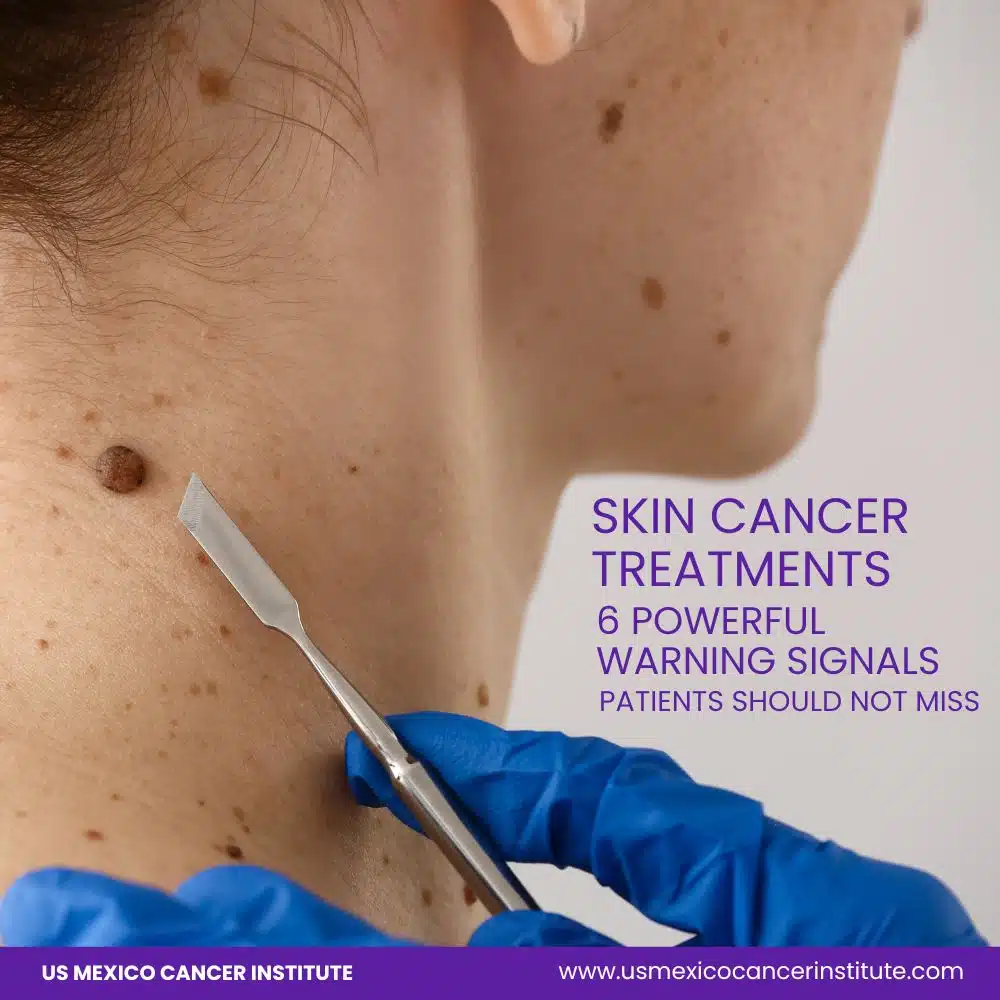
Skin Cancer Treatments — Why Patients Reach This Point
Skin cancer treatments become part of the conversation when a visible skin change begins to carry more weight than reassurance.
Patients may notice a lesion, a spot that changes over time, an area that does not heal, or irritation that feels unusual. They may visit a skin cancer clinic, receive imaging or biopsy results, and hear about next steps. Still, many leave with the same concern:
Something still feels unclear.
The plan often explains what may be removed, monitored, or treated.
It does not always explain what is happening inside the body.
At US Mexico Cancer Institute, we see this moment often.
Many patients believe the issue is only what appears on the skin. What we explain instead is different.
The skin reflects deeper biological activity.
The immune system continues responding throughout the process.
Natural killer cells often remain active, even when skin cancer has advanced.
The issue is not whether the body is responding.
It is how clearly the immune system is coordinating.
Understanding that difference changes how treatment decisions are made.
What Patients Are Told vs What We See
Patients exploring skin cancer treatments are often guided quickly toward procedures.
This creates a fixed belief:
- The visible lesion is the full problem
- Removing the visible issue solves the condition
- The immune system has little influence on what happens next
What we observe is different.
The skin is one of the body’s most active immune surfaces.
It is constantly monitored by immune cells.
It responds to inflammation, stress, and abnormal changes in tissue.
This matters because visible skin changes are often only part of the picture.
The National Cancer Institute explains that natural killer cells help identify abnormal cells without prior exposure.
This means immune coordination remains relevant throughout the course of care.
In our ebook “Natural Killer Cells – A Guide for Families and Loved Ones of Stage 4 Cancer Patients,” we explain that immune systems often remain active even when signaling becomes less clear. Immune overload is frequently misunderstood as immune absence.
This changes the perspective.
Treatment decisions should reflect more than what is visible.
They should reflect timing, immune coordination, and biological readiness.
6 Powerful Warning Signals Patients Should Not Miss
Why These Signals Matter Before Treatment Decisions
At US Mexico Cancer Institute, we do not begin with assumptions.
We begin with evaluation.
These six warning signals help patients understand how skin cancer behaves, how the immune system responds, and why timing matters before choosing a treatment path.
1. Visible Skin Changes May Reflect Deeper Activity
Visible changes are often the first sign patients notice.
These may include:
- changes in size or shape
- discoloration
- rough texture
- bleeding
- lesions that do not heal
These signs matter, but they do not always show the full biological picture.
Some visible changes reflect:
- tissue stress
- chronic inflammation
- deeper cellular disruption
This is why skin cancer treatments should begin with a structured review of what is happening beyond the surface.
At US Mexico Cancer Institute, we help patients understand that appearance alone does not define timing or alignment.
2. Natural Killer Cells Continue Monitoring Skin Tissue
Natural killer cells are part of the body’s early immune response.
They help monitor skin tissue continuously.
Unlike other immune cells that rely on prior exposure, NK cells respond to changes in cell identity. This makes them especially relevant in skin tissue, where environmental stress and abnormal cellular changes can develop over time.
When immune coordination is clear:
- recognition is more precise
- cell communication remains more structured
- immune response is more consistent
When signaling becomes disrupted:
- recognition slows
- communication weakens
- alignment changes
This is why nk cell treatment begins with understanding function rather than assuming absence.
In many patients, NK cells remain measurable even when symptoms feel more advanced.
3. Inflammation Can Reduce Signal Clarity
Inflammation plays a major role in how the body responds.
In skin-related conditions, inflammation can:
- affect healing
- disrupt immune signaling
- change tissue behavior
When inflammatory levels remain elevated:
- immune messages become less clear
- coordination weakens
- tissue recovery becomes less predictable
Research supported by the National Institute of Allergy and Infectious Diseases shows that chronic inflammation disrupts immune communication.
This matters because treatment decisions should account for how clearly the immune system is functioning at the time of care.
Reducing interference often improves clarity.
At US Mexico Cancer Institute, this is part of how we evaluate treatment alignment.
4. Timing Influences Healing and Alignment
Timing affects how skin cancer treatments align with the body’s condition.
Patients often assume options remain the same over time.
In reality, alignment changes as:
- inflammation changes
- tissue stress evolves
- immune coordination shifts
This is especially important for patients exploring:
- surgery
- topical approaches
- newer non-surgical pathways
Patients often ask about new treatment for skin cancer without surgery.
These options may be appropriate in some cases. However, availability alone does not determine whether they align.
Timing matters more than access.
Earlier evaluation helps preserve more structured options.
Waiting allows interference to increase and alignment to narrow.
5. Newer Treatment Paths Still Depend on Readiness
Patients exploring new treatment for skin cancer without surgery often hope newer approaches automatically offer better outcomes.
What matters more is biological readiness.
Even when a newer therapy is available, response still depends on:
- immune coordination
- tissue condition
- inflammation levels
- recovery capacity
This is why treatment decisions should not be based only on what is available.
They should be based on what aligns.
At US Mexico Cancer Institute, we help patients understand whether timing and biology support the path they are considering.
6. Cost Does Not Reflect Biological Alignment
Patients often ask about nk cell therapy cost mexico while comparing options for cancer treatment in mexico.
Cost is part of the decision.
It does not define readiness.
Two patients may receive similar therapies but have very different outcomes because their immune systems are functioning differently.
Treatment decisions should reflect:
- immune coordination
- tissue response
- timing
- overall condition
- safety oversight
This is why evaluation should come before comparison.
At US Mexico Cancer Institute, we guide patients through structured decisions rather than assumptions.
How These Signals Shape Treatment Decisions
Patients often focus on what is visible because that feels immediate.
However, understanding immune behavior adds a deeper level of clarity.
For example:
- some treatment paths may align better when immune coordination is stronger
- healing patterns may change depending on inflammation levels
- immune-based approaches depend on how well different systems are communicating
Visible skin changes do not always show the full biological picture.
When immune signals are clear, alignment improves.
When signaling becomes disrupted, response becomes less predictable.
This is why decisions should reflect both the visible condition and the body’s internal readiness.
How NK Cell Treatment Is Evaluated
At US Mexico Cancer Institute, immune therapy is never automatic.
Before recommending nk cell treatment, we evaluate how natural killer cells function within the current immune environment.
We assess:
• NK cell responsiveness
• Levels of inflammation affecting communication
• Immune signaling patterns between cells
• Oxidative stress levels
• Effects of recent treatments on recovery
• Overall immune coordination
In many patients, NK cells remain measurable even when coordination weakens.
The issue is not disappearance.
It is signaling interference.
We also identify timing windows where immune coordination improves.
This helps ensure decisions reflect measurable biology rather than assumption.
Why Patients Choose Our Approach
We differentiate ourselves in ways most providers cannot replicate:
• NK cells prepared with zero cryopreservatives for functional potency
• Molecular hydrogen support to reduce immune interference
• National-level medical leadership guiding decisions
• COFEPRIS-aligned safety oversight
• White-glove care that protects timing and reduces stress
At US Mexico Cancer Institute, safety and precision guide every step.
Our protocols align with standards established by COFEPRIS, Mexico’s Federal Commission for the Protection Against Sanitary Risk.
When patients compare options, one truth becomes clear:
Precision and timing define what remains possible.

How This Changes the Decision
Understanding these warning signals changes how patients evaluate care.
It shifts the focus from reacting to visible changes to understanding readiness.
At US Mexico Cancer Institute, we guide patients through structured evaluation so decisions reflect biology, timing, and coordination.
This helps patients move forward with greater clarity.
Timing Matters Now
Immune coordination changes over time.
What aligns today may not align in the same way later.
At US Mexico Cancer Institute, we see how early evaluation leads to more precise decisions while coordination still remains.
If you are exploring skin cancer treatments, reviewing options at a skin cancer clinic, or considering cancer treatment in mexico, this is the moment to act.
Evaluate immune readiness now.
Protect timing now.
Preserve options while alignment still exists.
FAQs
1. What are skin cancer treatments?
They include procedures and therapies used to manage abnormal skin cells.
2. Do natural killer cells play a role in skin cancer?
Yes. They help monitor abnormal cellular changes.
3. Is there new treatment for skin cancer without surgery?
Yes. Some newer approaches may be available depending on the condition.
4. What is nk cell treatment?
It is an approach that evaluates immune coordination before therapy decisions.
5. Does nk cell therapy cost mexico determine effectiveness?
No. Effectiveness depends on biological alignment and timing.

- NK Cell Therapy in Mexico: Patient Guide for Cancer Treatment in Tijuana - August 25, 2026
- NK Cell Therapy Mexico 6 Essential Standards Patients Should Evaluate Before Treatment - August 18, 2026
- Alternative Cancer Treatments Mexico 6 Essential Questions Patients Should Ask About Evidence and Safety - August 11, 2026