
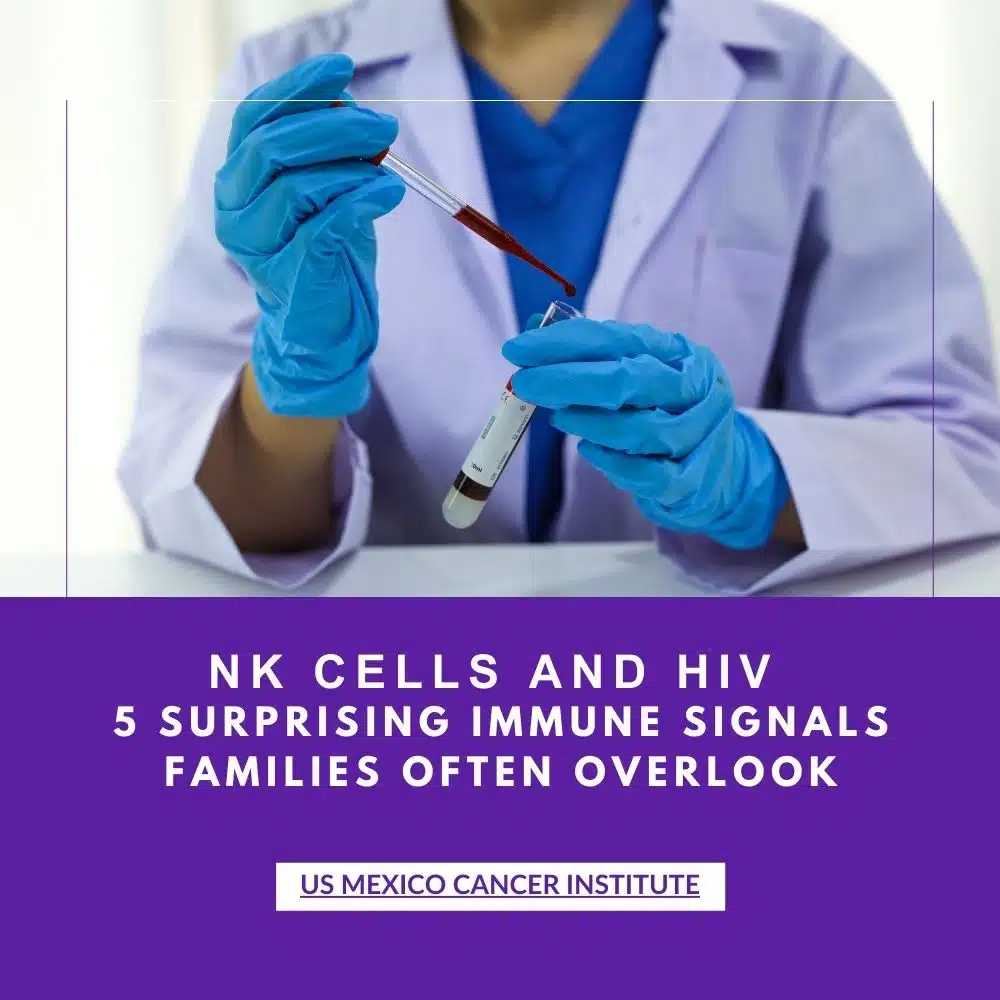
NK Cells and HIV
NK cells and HIV often appear in conversations when families begin exploring how the immune system responds to long-term viral illness. Many people understand HIV as a virus that weakens immunity over time, but fewer people realize that natural killer cells remain active participants in the body’s defense even after infection.
At US Mexico Cancer Institute, we often speak with families who want to understand whether immune clarity still exists and whether immune coordination can be measured before making treatment decisions. They are not only asking how HIV affects the immune system. They want to know how nk cells behave in this environment and whether immune response still holds structure.
Understanding the interaction between natural killer cells and HIV reveals signals that many patients overlook. Those signals help explain how immune timing works and why evaluation matters.
How NK Cells Respond to Viral Infection
To understand the role of nk cells in hiv, we first look at how natural killer cells behave in viral infections.
NK cells belong to the innate immune system. Their job is to detect abnormal signals from infected cells and respond early, often before other immune cells fully activate. Unlike adaptive immune cells, they do not require prior exposure to recognize a threat.
The National Cancer Institute describes natural killer cells as immune cells capable of destroying infected or abnormal cells without needing previous sensitization.
In HIV infection, NK cells participate in early defense by identifying infected immune cells. However, chronic viral exposure gradually changes immune signaling patterns. Over time, persistent inflammation may interfere with NK cell coordination.
This does not mean NK cells disappear. In many patients, hiv natural killer cells remain measurable even when immune balance becomes strained.
In our ebook, Natural Killer Cells – A Guide for Families and Loved Ones of Stage 4 Cancer Patients, we explain that immune exhaustion is frequently misunderstood. Families are often told immune function has collapsed. What we repeatedly observe is different. NK cells are often still present but suppressed by inflammatory signaling.
That difference matters for timing.
5 Surprising Immune Signals Families Often Overlook
HIV changes immune signaling gradually. These five immune signals explain how nk cells and hiv interact and why immune evaluation helps families understand timing.
1. NK Cells Respond Early in HIV Infection
The role of nk cells in hiv begins very early in infection. NK cells recognize infected immune cells and release enzymes that trigger programmed cell death.
This early activity helps slow viral spread before adaptive immune responses develop.
Research supported by the National Institute of Allergy and Infectious Diseases confirms that NK cells play an important role in controlling viral replication during early infection stages.
However, early response does not guarantee long-term coordination. Chronic inflammation may gradually interfere with signaling precision.
2. Chronic Inflammation Weakens Immune Clarity
Long-term viral infection increases inflammatory signals throughout the immune system.
In patients studying natural killer cells and hiv, researchers often observe that NK cells remain present but become less responsive over time. Persistent inflammation disrupts the balance between activating and suppressive signals.
When inflammatory burden remains high, NK cells lose precision in recognizing abnormal cells. This gradual shift often appears as immune exhaustion, even though NK cells are still measurable.
Reducing inflammatory interference may restore clearer immune coordination.
3. HIV Changes NK Cell Communication With Other Immune Cells
NK cells do not operate alone. They coordinate with T cells, dendritic cells, and other immune pathways.
In HIV infection, these communication pathways change. Viral persistence alters cytokine signaling, which affects how NK cells receive and send immune messages.
Understanding hiv natural killer cells requires evaluating the broader immune environment, not simply measuring cell counts.
At US Mexico Cancer Institute, we assess immune coordination rather than relying solely on blood numbers. Signaling clarity matters more than presence alone.
4. NK Cell Activity May Fluctuate Over Time
Immune response in HIV is not static. NK cell responsiveness may rise and fall depending on treatment cycles, viral activity, and inflammatory load.
Patients often assume immune decline happens in a straight line. In reality, NK activity may partially recover during periods when inflammation decreases.
These timing windows matter. When immune clarity improves, evaluation can reveal whether nk cells therapy aligns with measurable readiness.
5. NK Cells Remain Part of Long-Term Immune Surveillance
Even in chronic viral illness, NK cells continue to monitor infected cells and abnormal signals.
Understanding nk cells and hiv requires recognizing that immune systems adapt over time. NK cells may shift their behavior but rarely disappear entirely.
When immune coordination remains measurable, immune-based strategies may still align with patient goals.
The key step is structured evaluation.
How NK Cell Treatment Is Evaluated
At US Mexico Cancer Institute, immune therapy is never automatic.
Before recommending nk cell treatment, we evaluate how NK cells are functioning within the current immune environment.
Our assessment includes:
• NK cell responsiveness and activation patterns
• Overall inflammatory burden affecting immune precision
• Cytokine signaling that influences immune coordination
• Oxidative stress levels that interfere with cell signaling
• Effects of current or recent treatment cycles
• Overall immune communication between cell systems
From our experience across cancer, viral illness, and autoimmune disorders, NK cells often remain measurable even when coordination weakens.
The challenge is rarely absence. It is signaling interference.
Evaluating immune readiness helps determine whether immune-based therapy aligns with biological timing.
Why Patients Choose Our Approach
We differentiate ourselves in ways most providers cannot replicate:
• NK cells prepared with zero cryopreservatives for functional potency
• Molecular hydrogen support to reduce immune interference
• National-level medical leadership guiding decisions
• COFEPRIS-aligned safety oversight
• White-glove care that protects timing and reduces stress
NK cells prepared with zero cryopreservatives maintain stronger signaling integrity. Molecular hydrogen helps reduce oxidative stress that interferes with immune coordination.
Our protocols align with standards established by COFEPRIS, Mexico’s Federal Commission for the Protection Against Sanitary Risk, which regulates cellular therapies and patient protection.
Precision and timing guide every immune decision.
How Understanding NK Cells Helps Families Decide
Families researching HIV often focus on viral control alone. Yet immune coordination plays an equally important role in understanding long-term health.
Recognizing how natural killer cells and hiv interact helps families ask better questions about immune readiness.
At US Mexico Cancer Institute, we guide patients through immune evaluation so decisions reflect measurable coordination rather than assumption.
Measure Immune Clarity Before Timing Narrows
In chronic viral illness, immune coordination changes gradually. NK cells often remain measurable even when inflammation persists.
At US Mexico Cancer Institute, we evaluate immune readiness while flexibility still exists.
If you are researching nk cells and hiv, the next step is not assumption. It is structured immune evaluation.
Measure immune coordination now.
Protect timing now.
Preserve options while immune clarity remains measurable.
FAQs
1. What is the role of nk cells in hiv?
The role of nk cells in hiv involves identifying infected cells early and helping limit viral spread through immune surveillance.
2. Do nk cells disappear during HIV infection?
No. In many cases, NK cells remain present but may become less responsive due to chronic inflammation.
3. What is NK cell treatment?
What is NK cell treatment? It is a medical approach that evaluates and supports natural killer cell coordination when immune readiness is measurable.
4. Can nk cells therapy help viral immune response?
Immune-based therapy may align with some conditions when immune clarity remains measurable. Evaluation determines suitability.
5. When should immune evaluation happen?
Evaluation should occur early, before long-term inflammatory signaling reduces immune coordination.

- NK Cell Therapy in Mexico: Patient Guide for Cancer Treatment in Tijuana - August 25, 2026
- NK Cell Therapy Mexico 6 Essential Standards Patients Should Evaluate Before Treatment - August 18, 2026
- Alternative Cancer Treatments Mexico 6 Essential Questions Patients Should Ask About Evidence and Safety - August 11, 2026