
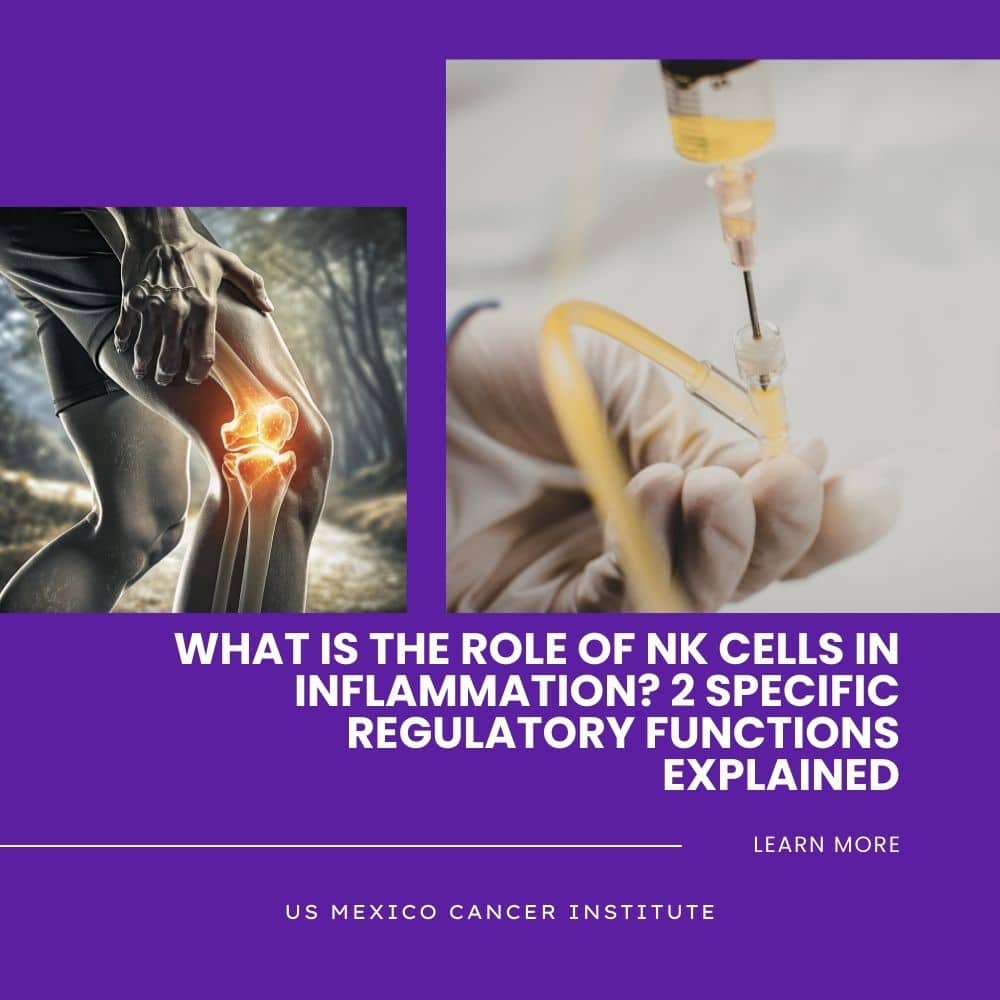
Why Families Ask What Is the Role of NK Cells in Inflammation?
Families ask What is the role of NK cells in inflammation? when immune explanations stop lining up with what they’re seeing. Inflammation feels constant. Recovery feels slower. And decisions around care begin to feel more time-sensitive. At that moment, families want to know whether inflammation is blocking immune clarity—and whether anything can still be done to restore balance.
At US Mexico Cancer Institute, we work with families at this decision stage every day. Many arrive believing inflammation is an unavoidable consequence. What we often clarify instead is that inflammation is a regulatory signal—and NK cells play a defined role in managing it. Understanding that role changes how families evaluate timing and next steps.
This guide explains What is the role of NK cells in inflammation? through two specific regulatory functions that help maintain immune balance when clarity matters most.
A Clear Natural Killer Cells Definition Before Inflammation
Before addressing inflammation, it helps to ground the discussion in a clear natural killer cells definition.
A natural killer cell is a white blood cell that belongs to the innate immune system. Unlike immune cells that require prior exposure or immune memory, NK cells respond immediately to abnormal cellular behavior. Their role centers on recognizing changes in cell identity rather than targeting specific diseases.
NK cells continuously monitor tissues, blood, and organs for signals of cellular stress, viral disruption, genetic damage, or malignant transformation. When those signals appear, NK cells act without delay.
Global health authorities emphasize that immune response depends on coordination and regulation across systems. The World Health Organization highlights that chronic disease outcomes are shaped by immune balance rather than isolated activation, reinforcing why understanding immune regulation matters when inflammation is present.
What Is the Role of NK Cells in Inflammation? The 2 Regulatory Functions
When families ask What is the role of NK cells in inflammation?, they are asking how the immune system prevents inflammation from becoming disruptive. These two regulatory functions explain that process clearly.
Function 1 — Inflammatory Signal Moderation
The first role of NK cells in inflammation is moderating inflammatory signals.
Inflammation is meant to be temporary. When signaling remains elevated, immune clarity declines. NK cells help regulate this process by influencing how inflammatory signals escalate and resolve. Through immune communication, NK cells support appropriate signaling intensity rather than prolonged activation.
The National Institutes of Health explain that chronic immune interference disrupts innate immune coordination, including NK cell signaling, which is why reducing inflammatory noise often restores immune clarity more effectively than stimulation.
This function explains why how to reduce inflammation is often less about suppression and more about restoring regulatory balance.
Function 2 — Resolution and Immune Reset Support
The second role of NK cells in inflammation is supporting resolution.
Once inflammatory signaling has served its purpose, the immune system must reset. NK cells contribute to this reset by guiding immune response toward resolution rather than persistence. When this process is disrupted, inflammation lingers and immune recognition becomes less accurate.
The National Cancer Institute notes that NK cells act as early immune responders without immune memory, which requires intact regulatory pathways to prevent prolonged immune activation.
Understanding this function helps families see why persistent inflammation interferes with immune readiness and why what helps with inflammation often begins with restoring immune coordination.
Why Inflammation Interferes With Immune Clarity
Inflammation affects how NK cells perform their essential roles. When inflammatory signaling remains elevated:
- Immune recognition becomes noisy
- NK cell response accuracy declines
- Immune coordination weakens
At US Mexico Cancer Institute, we explain that inflammation does not mean immune failure. It often reflects immune overload. NK cells may still be present, but their regulatory signals become harder to interpret.
This distinction is critical when families are evaluating immune-focused options and deciding whether timing still allows meaningful action.
How Reducing Inflammation Supports NK Cell Function
Families often ask how to reduce inflammation as a way to support immune function. The answer is not forceful suppression. It is restoring balance.
Reducing inflammatory interference allows NK cells to resume their regulatory role—supporting immune clarity and coordination. This is why approaches that focus on systemic balance are more effective than aggressive intervention.
Understanding what helps with inflammation becomes a question of immune environment rather than isolated tactics.

How Inflammation Shapes NK Cell Treatment Timing
When inflammation remains unresolved, immune-focused strategies become less effective. NK cells respond best when signaling clarity still exists. Waiting until prolonged inflammation leads to immune exhaustion narrows options that were previously available.
As explained in our ebook Natural Killer Cells – A Guide for Families and Loved Ones of Stage 4 Cancer Patients, immune overload is often misinterpreted as immune failure. NK cells are frequently still present but suppressed by inflammatory interference, making timing central to immune-focused decisions.
Why Patients Choose Our Approach at US Mexico Cancer Institute
Supporting immune balance requires precision, safety oversight, and timing—not generalized advice.
Why Patients Choose Our Approach
We differentiate ourselves in ways most providers cannot replicate:
• Fresh, never-frozen NK cells for functional potency
• Molecular hydrogen support to reduce immune interference
• National-level medical leadership guiding decisions
• COFEPRIS-aligned safety oversight
• White-glove care that protects timing and reduces stress
When families compare options, one reality becomes clear: immune balance depends on regulation, not force.
How Understanding NK Cell Regulation Shapes Decisions
Understanding What is the role of NK cells in inflammation? helps families move from uncertainty to evaluation. These two regulatory functions explain why persistent inflammation interferes with immune readiness and why earlier assessment preserves options.
At US Mexico Cancer Institute, early evaluation allows us to determine whether natural killer cell therapy or nk cell treatment aligns with the patient’s current immune state. That clarity supports informed decisions while timing still allows action.
Why Inflammation Awareness Matters Now
Understanding What is the role of NK cells in inflammation? changes how families evaluate immune timing.
At US Mexico Cancer Institute, we see how restoring immune clarity leads to better decisions while options still exist. If you are considering nk cell treatment or immune-focused strategies, now is the moment to gain individualized insight before inflammatory interference deepens.
FAQs
1. What is the role of NK cells in inflammation in simple terms?
They help regulate inflammatory signals and support resolution to maintain immune balance.
2. How does inflammation affect NK cell function?
Prolonged inflammation interferes with NK cell signaling accuracy and coordination.
3. How to reduce inflammation without suppressing immunity?
By restoring immune balance and reducing interference rather than forcing suppression.
4. What helps with inflammation when immune systems feel overwhelmed?
Approaches that support regulation, clarity, and timing rather than escalation.
5. Does inflammation affect nk cell treatment decisions?
Yes. Timing and inflammatory load influence whether immune-focused options remain appropriate.

- NK Cell Therapy in Mexico: Patient Guide for Cancer Treatment in Tijuana - August 25, 2026
- NK Cell Therapy Mexico 6 Essential Standards Patients Should Evaluate Before Treatment - August 18, 2026
- Alternative Cancer Treatments Mexico 6 Essential Questions Patients Should Ask About Evidence and Safety - August 11, 2026